報價的準確性取決於其背後的需求。 您或許只提供了一個零件編號、一個數量以及一份簡短的交貨單,但積體電路經銷商仍須解答其中隱含的問題:後綴是否完整?封裝形式是否已確定?組裝是否需要工業級溫度規格?批次中能否包含混合的生產日期代碼?貨物出貨時必須附上哪些原產地證明?
我在電子元件採購領域已有超過 15 年的工作經驗。當我審閱報價請求(RFQ)時,首先會確認元件規格、應用限制、品質等級、交貨需求,以及可接受的採購途徑。若這些要點不夠明確,即使能快速提供報價,結果仍可能有誤。.
本指南將工程需求轉化為積體電路分銷商可據以執行的指示。內容涵蓋向電子元件分銷商索取樣品、下達生產訂單、短缺元件的替代採購,以及多產品線物料清單(BOM)的採購事宜。.
為何清晰的技术溝通至關重要
減少零件編號錯誤與採購風險
積體電路(IC)的名稱並非完整的採購規格。同一個產品系列可能包含多種封裝形式、引腳數、溫度範圍、速度等級、引腳鍍層及認證等級。即使只少了一個字母,也可能導致產品不符規格。.
請提供完整的製造商零件編號,而非縮寫的內部名稱。請將您的內部庫存編號填寫在另一欄中。.
關鍵點很簡單:分銷商不應該需要猜測哪項差異才重要。請將每項需求標記為以下其中一類:
- 必填: 引用的部分必須完全一致。.
- 首選: 或許可以考慮另一種方案。.
- 開放時間: 經銷商可能會建議合適的選擇。.
此舉可防止某項偏好設定被視為強制性設定,並確保硬性限制仍可見。.
提升報價與交貨效率
一份清晰的報價請求(RFQ)能減少往返的電子郵件次數。採購團隊可篩除不合適的庫存,並提供一份報價供您的工程與品質團隊審核。.
請針對交貨日期給出一個明確的定義。「需要儘快」這個說法沒有固定含義。請說明您所指的是貨物離開供應商之日、送達您的貨運代理之日、完成通關之日,還是抵達您工廠之日。.
若這些步驟會影響時程,請要求 IC 經銷商將庫存確認、檢驗、文件準備及運輸等環節分開處理。.
預防品質糾紛與額外成本
許多爭議早在簽發採購訂單之前就已萌生。一方期望獲得原廠密封且具備完整可追溯性的零件;另一方則將已拆封但未使用的物料視為新品。「新品」一詞並不足夠。.
請以淺顯易懂的語言闡明條件。請明確說明是否要求原廠包裝、密封的捲軸或托盤、單一批次、單一生產日期代碼、約定的生產日期代碼範圍、未使用材料,或是已通過指定檢驗計畫的零件。.
優質的語言必須能夠驗證。「品質優良」這個說法過於籠統。「無彎曲引線、防潮袋完好無損、可見製造商標籤、有記錄的批號,以及裝運前照片」這些項目則可以進行核對。.
請提供完整的 IC 型號及規格
請確認完整的零件編號、品牌及製造商
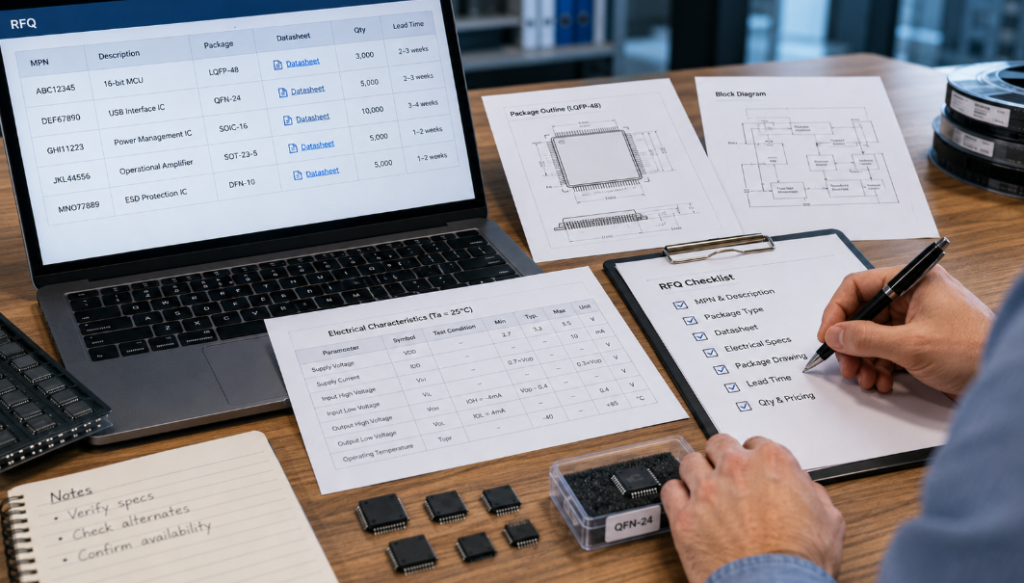
請先提供確切的製造商零件編號(MPN)。即使品牌名稱看似熟悉,也請一併提供製造商名稱。因為資料庫可能會將多家製造商的產品歸類在同一個裝置名稱之下。.
請為每個經核准的製造商及其 MPN 分別設置獨立的行。並新增狀態欄位,例如「主要」、「經核准的替代方案」或「需進行工程審查」。“
當您採購時 積體電路, ,該後綴通常包含採購細節。經銷商應將該後綴與製造商的最新資料表、封裝圖、訂購資訊及產品生命週期公告進行比對。.
狀態分級、溫度等級與關鍵參數
資料表中可能會列出許多規格限制。您的報價請求應明確指出哪些規格是採購的決定性因素。以微控制器(MCU)為例,這些規格可能包括記憶體、速度、電壓、介面、封裝及溫度等級;若為類比積體電路(IC),則可能包括偏移、雜訊、頻寬、供電範圍及通道數。.
“「QFN」並未標明封裝尺寸、引腳數、裸露墊片、間距或高度。請使用製造商的封裝代碼,並針對相似變體補充圖號。.
適用於諸如 工業自動化設備, ,同時也列出影響選型的環境與服務限制條件。這些可能包括運作溫度、振動暴露程度、預期產品壽命、維修支援,以及該零件是否必須在預定的生產期間內持續供應。.
請附上資料表或產品連結
請附上工程部門所使用的資料表版本。附有日期標示的 PDF 檔案可讓雙方擁有相同的參考依據。請標示出包含控制限值的頁面或表格行。.
請使用如下所示的簡單 RFQ 欄位集:
| 詢價單欄位 | 應填寫什麼內容 | 為何積體電路經銷商需要它 |
|---|---|---|
| 製造商零件編號 | 包含所有前綴和後綴的完整 MPN | 識別可訂購的特定裝置 |
| 製造商 | 合法品牌或經核准的製造商 | 避免跨品牌假設 |
| 套裝 | 製造商封裝代碼、腳位數、包裝方式 | 確認滑板的合身度與操控性 |
| 技術上的限制 | Only the parameters that control approval | Guides stock filtering and alternate review |
| Datasheet reference | File name, revision, date, or official link | Creates one technical reference |
| Application note | End use and risk level without sharing restricted details | Helps flag grade, lifecycle, or documentation concerns |
| Substitution status | Not allowed, approved list only, or open to review | Stops unapproved cross-references |
Define Quantity, Delivery, and the Purchasing Plan
Separate Samples from Production Demand
Keep prototype and production quantities on separate lines. Supply channel, packaging, minimum pack, and inspection may differ.
State sample, pilot, first production, and repeat demand separately. If samples must match the later production lot, say so before sourcing.
State whether split delivery is allowed. It may protect a build date but add receiving work, freight, and mixed-lot control.
Give a Target Arrival Date
Use a required-on-site date and shipping destination. The distributor can work backward through inspection, packing, transit, customs, and delivery.
If the schedule has room, give the requested date and the last acceptable date.
Ask the quote to state whether inventory is physically verified, supplier-reported, or subject to final confirmation. “In stock” can refer to several locations and levels of control.
Share Ongoing or Annual Demand
An annual forecast is not a purchase order. It helps an Electronic Component Distributor plan regular releases, buffer stock, or lifecycle support. Mark each period as firm, planned, or estimated.
The core issue is demand timing, not just total volume. A large annual number with no release plan may lead to a sourcing route that does not fit your warehouse space, cash cycle, or shelf-life controls.

Explain Quality and Compliance Requirements
Define Original, New, and Traceable
Use exact words for the evidence you expect. “Original” may refer to the manufacturer, packaging, supply channel, or all three.
A stronger request may include:
- Original manufacturer and correct MPN
- New and unused condition
- Original manufacturer packaging when required
- Lot and date-code visibility
- Chain-of-custody or source traceability
- Certificate of Conformance when required
- Pre-shipment inspection photos
- Independent testing under an agreed scope
Match the control level to the risk. A prototype and a long-life regulated program may need different evidence.
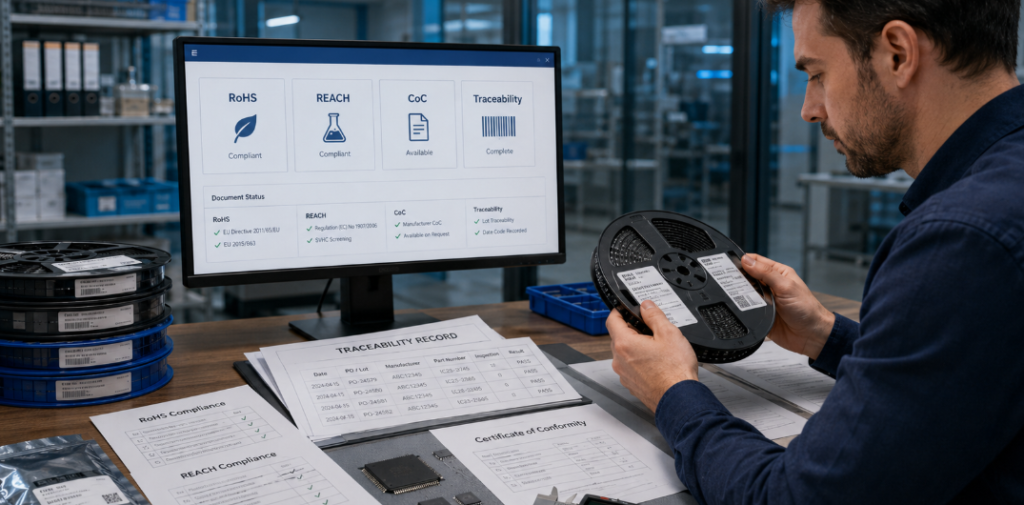
State RoHS and REACH Needs Correctly
Do not write only “RoHS required.” State the destination market, required declaration type, accepted exemption status, and document date.
該 歐盟委員會的《有害物質限制指令》(RoHS)指引 explains that covered electrical and electronic equipment is subject to restrictions on ten substances, with defined exclusions and exemptions. A buyer should check whether the selected component documentation supports the finished product’s compliance route.
For REACH, ask for the manufacturer’s current substance declaration and name the Candidate List reference date your compliance team uses. The ECHA 候選清單 can create legal duties when a substance is added, so an old general statement may not answer a current project requirement.
Your IC distributor should not be asked to give legal approval for your end product. The distributor can collect and pass on manufacturer declarations, material data, and available compliance records. Your own product compliance team decides whether that evidence is enough for the target market.
Name the Test Reports and Quality Documents
“Test report required” is too broad. State the test type, sample size, laboratory requirement, acceptance criteria, and whether destructive testing is allowed.
Possible records include visual inspection, marking review, X-ray, XRF screening, solderability, decapsulation, electrical testing, packing photos, CoC, lot records, and manufacturer traceability. No single method proves everything. Match the plan to the source risk and part type.
For high-reliability supply chains, define the traceability level before quotation. The IPC standards status page identifies standards covering supply-chain traceability, product-change notification, product discontinuance, handling, marking, and other electronics controls. Use a named standard only when your quality system truly requires it.
Clarify Budget and Commercial Terms
Give Useful Budget Guidance Without Weakening Quality
You do not need to publish a fixed target. State whether the project has a cost ceiling, whether quality and traceability are fixed, or whether you want separate sourcing options.
Tell the distributor which trade-off is allowed: delivery date, packaging, split shipment, or manufacturer review.
Do not ask the supplier to meet a budget by silently changing the quality level. Keep technical, quality, and commercial deviations visible in the quotation.
Confirm Payment Method and Trade Terms
State the requested payment method, billing currency, Incoterm, and named place. Do not write only “FOB” or “DAP.” The named port, airport, warehouse, or city matters.
Ask whether bank charges, documents, inspection, and special packing are included or separate.
Assign Shipping, Insurance, Duties, and Tax Responsibility
Give the ship-to country, postal code, consignee type, and carrier account. State whether you will use your forwarder or need delivered service.
State who arranges cargo insurance and who handles import duties and taxes. Also list shipping limits such as no postal service, no mixed cartons, moisture barrier packaging, ESD protection, dry pack, desiccant, humidity indicator card, or label format.
Handle Substitutes and Stock Shortages Safely
State Whether Compatible Alternates Are Allowed
A compatible part is not always drop-in. Pinout may match while timing, thermal behavior, firmware support, accuracy, qualification, or package height does not.
Use one of three instructions: no substitutes, approved alternates only, or distributor suggestions allowed for engineering review. Never let “equivalent” mean automatic approval.
The distributor presents a documented option. Engineering approves technical fit; quality and procurement approve the source, evidence, and supply impact.
Require a Parameter Comparison and Sample Test
Ask for a side-by-side comparison focused on the parameters your design uses. A one-page gap list is often easier to review than two full datasheets.
| Review Area | What the Distributor Should Provide | Buyer Action |
|---|---|---|
| 身分 | Manufacturer, full MPN, lifecycle status | Confirm approved brand policy |
| Mechanical fit | Package drawing, dimensions, pinout, marking | Check PCB, assembly, and inspection impact |
| Electrical fit | Supply range, timing, accuracy, current, thermal limits | Complete engineering review |
| Software impact | Register map, boot behavior, drivers, errata | Review firmware and create a test plan |
| 合規 | RoHS, REACH, qualification, available declarations | Complete quality and compliance review |
| Supply risk | Lead time, source type, PCN/PDN history, expected availability | Complete procurement and lifecycle review |
| Validation | Sample quantity, lot details, available test data | Approve a sample build before production |
Sample approval should name the exact alternate MPN and revision. A general statement such as “alternate tested” is hard to trace later.
Check Discontinuation, Lifecycle, and Supply Risk
Ask whether the original part is active, not recommended for new designs, end of life, obsolete, or subject to a product discontinuance notice. Request the notice date and last-order date when available.
Ask whether the alternate is a long-term solution or a shortage bridge. It may solve one build and fail the next supply plan.
Your RFQ should state the planned product life and service period. This helps the IC distributor avoid suggesting a part that meets the electrical need but has a weak supply outlook.
Use a Standard RFQ to Improve Communication
Create One BOM or RFQ Template
A standard template gives engineering, purchasing, quality, and suppliers the same fields. Keep one line per MPN and use controlled status values when possible.
At minimum, include the MPN, manufacturer, description, quantity, package, datasheet reference, required arrival date, ship-to location, compliance needs, traceability level, packaging rule, substitution status, and notes.
A clean BOM helps the Electronic Component Distributor work faster and gives your team a better approval and receiving record.
Mark Critical Parameters and Non-Replaceable Conditions
Do not hide hard limits inside a long note. Add a “must match” column. Use it for safety rating, package footprint, temperature grade, qualification, firmware dependency, approved manufacturer, or any condition that blocks substitution.
Mark confidential or export-controlled information before sharing files. Send only the application detail needed for sourcing and technical review.
The point is to create enough context for a good decision without sending uncontrolled project data.
Record Quote Versions and Communication
Give each RFQ a number and revision. Ask suppliers to quote against that revision. When a quantity, date, MPN, compliance need, or shipping term changes, issue a new revision rather than editing an old email thread without a record.
Keep the manufacturer, MPN, quantity, lot condition, date code, source type, lead time, documents, Incoterm, validity, and deviations in one comparison sheet.
A good quote does more than answer “available or not.” It shows what was checked, what remains open, and what differs from your request. That is the level of communication you should expect from an experienced IC distributor.
結論
Clear communication with an IC distributor starts with exact part identity and ends with a controlled record of what both sides agreed to supply. Define the MPN, package, limits, quantity, delivery point, evidence, terms, and alternate rules before ordering.
From my experience, the best RFQs are not the longest. They make decisions easy. Required points are visible. Flexible points are labeled. Open risks are written down. The distributor can spend time finding the right supply path instead of decoding the request.
如果您正在採購電子元件, Duolink Electronics is an independent supplier supporting integrated circuits, semiconductors, passive components, connectors, BOM sourcing, part-number checks, stock inquiries, and hard-to-find component requests. You can send your BOM or component inquiry to the sourcing team for review.
常見問題
我應向積體電路經銷商提供哪些最低限度的技術資訊?
請提供完整的製造商零件編號、製造商名稱、數量、包裝規格、所需到貨日期、運送目的地、替代規則,以及任何既定的技術或品質限制。請附上工程部門所採用之資料表的修訂版本。若不確定後綴為何,請標示該處,切勿憑空猜測。.
我是否應該在每次訂購積體電路時,都要求提供最新的生產日期代碼?
不。僅當您的品質系統、儲存計畫、客戶合約、可焊性風險或受監管計畫有此需求時,才應設定日期代碼限制。.
僅憑日期代碼並不能證明商品的真偽或儲存狀況良好。請一併詢問批次狀況、包裝、可追溯性及檢驗證明等相關資訊。.
IC 分銷商能否批准將替代元件用於我的設計?
經銷商可識別並比較可能的替代方案。貴公司的工程團隊應審核其電氣、機械、熱設計、韌體及可靠性方面的適用性。.
品質與採購部門應在投入生產使用前,核准供應來源、合規證明、驗證計畫及供應風險。.
當商品有庫存但包裝不同時,我該怎麼辦?
請經銷商說明包裝方式的具體差異,以及這些差異對數量、處理、濕度控制、拾放設定、標籤及可追溯性所產生的影響。.
工程或生產部門可接受托盤裝、管裝、裁切膠帶或重新捲繞的材料,但此變更須在訂單確認前獲得批准。.



 Chinese
  English
  German
  Spanish
  French
  Italian