The main types of memory ICs are SRAM, DRAM, ROM, PROM, EPROM, EEPROM, Flash, FRAM, and MRAM. SRAM and DRAM provide temporary working memory. ROM and its programmable variants store fixed or updateable information, while EEPROM and Flash retain data without power. FRAM and MRAM also retain data and suit applications that need frequent updates.
For an engineer, the choice starts with how the system uses its data. For a buyer, it starts with the approved part number and the parameters that must match. A chip with the right capacity can still have the wrong voltage, interface, timing, or programming behavior. DuoLink Electronics supports IC sourcing and BOM inquiries, where these differences need to stay visible throughout the quotation process.
What Is a Memory IC?
A memory integrated circuit stores digital information, including program instructions, temporary calculations, configuration settings, and recorded data. It may be a separate chip on a circuit board or a memory block inside a microcontroller or processor.
A typical embedded product uses several memory types together. Working data goes into RAM, firmware may be stored in Flash, and calibration values may be saved in EEPROM. Each serves a different purpose.
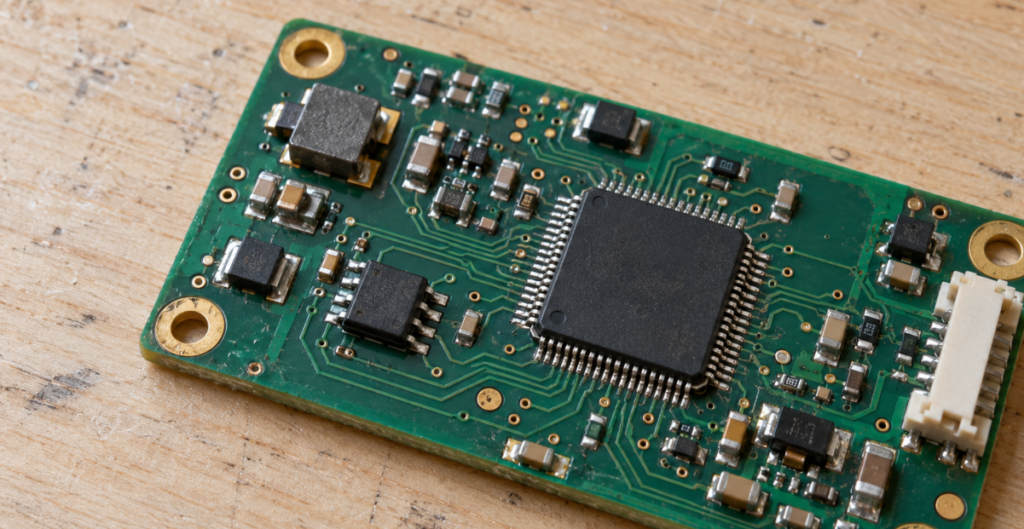
Memory ICs also differ from memory modules. A DRAM chip is an IC; a DIMM is an assembled module containing memory chips and other circuitry. An SSD is a storage product with a controller and NAND Flash. These descriptions should stay separate when requesting a quote.
If you need a broader introduction, DuoLink’s guide to integrated circuit types and applications explains where memory fits among other IC families.
Before selecting a device, confirm both capacity and organization. A 64-Mbit memory contains 8 Mbytes of raw storage capacity because one byte contains eight bits. Organization, such as x8 or x16, describes the data width and can affect controller compatibility.
Volatile vs. Non-Volatile Memory
Volatile memory needs power to retain its contents. Conventional SRAM and DRAM fall into this category. They hold the information a system is actively processing, and their contents are lost when the required supply disappears.
Non-volatile memory retains stored information without continuous power. This group includes ROM, PROM, EPROM, EEPROM, NOR Flash, NAND Flash, FRAM, and MRAM.
| Memory type | Retains data without power? | Typical role | Main selection check |
|---|---|---|---|
| SRAM | Nein | Working buffers and cache | Access timing, interface, standby current |
| DRAM | Nein | Larger working memory | Controller support, generation, organization |
| ROM / PROM / EPROM | Ja | Fixed code and legacy firmware | Programming method and existing contents |
| EEPROM | Ja | Settings and calibration | Write endurance, page behavior, interface |
| NOR Flash | Ja | Boot code and firmware | Read commands, erase layout, boot compatibility |
| NAND Flash | Ja | Larger code and data storage | ECC, bad-block handling, controller support |
| FRAM / MRAM | Ja | Frequently updated persistent data | Interface, timing, endurance, retention conditions |
Non-volatile does not mean data lasts forever. Retention specifications apply under defined conditions, including temperature and, for some technologies, accumulated writes. Endurance is a separate measure: it describes how much writing or cycling a device supports under the manufacturer’s stated conditions.
Power loss during an update also needs attention. A memory may preserve completed writes while an interrupted transaction leaves a record incomplete. Engineers should define how the application detects and recovers from that condition.
For procurement, record retention and endurance requirements separately. A request for “non-volatile memory” alone leaves too much room for a technically unsuitable quotation.
SRAM and DRAM: The Main Types of RAM
SRAM
Static random-access memory stores bits in circuits that retain their state while power is supplied. It does not need the periodic refresh used by DRAM. SRAM is common in processor caches, small working buffers, and embedded applications that need straightforward memory access.
Many SRAM blocks are built inside processors and microcontrollers. Separate SRAM ICs are also available with parallel or serial interfaces. A serial SRAM does not offer the same system access behavior as a parallel SRAM simply because both use the same storage technology.
For a replacement, compare access time, supply voltage, pinout, data width, and control signals. In a battery-powered product, standby current and the specified data-retention supply voltage may also matter.
Ordinary SRAM remains volatile. Battery-backed SRAM and devices that combine SRAM with a non-volatile backup mechanism require a separate review of their backup behavior.
DRAM
Dynamic random-access memory stores information as charge that must be refreshed periodically. Its density makes it suitable for larger working-memory requirements, including computers, communications equipment, and embedded processing systems.
SDRAM is synchronous DRAM. DDR SDRAM transfers data on both clock edges, and DDR generations are distinct interface families. LPDDR is designed for low-power applications and also has generation-specific requirements.
A DDR4 device is not a general substitute for DDR3 or DDR5. The processor’s memory controller, board design, power supplies, organization, and timing configuration determine which devices can work.
When sourcing DRAM, retain the complete manufacturer part number and speed and temperature grades. Engineering should approve a proposed alternate using its datasheet and controller requirements, even when capacity and package appear to match.
ROM, PROM, and EPROM
These names describe non-volatile memories with different ways of setting or changing their contents. They are especially relevant when supporting older equipment.
ROM means read-only memory. In mask ROM, the manufacturer fixes the contents during production. A device with the right package and capacity but the wrong programmed contents will not perform the intended function.
PROM, or programmable read-only memory, allows one-time programming after manufacture. Once programmed, a conventional PROM cannot be erased and reused. Buyers should specify whether they need blank devices or parts containing an approved image.
EPROM stands for erasable programmable read-only memory. A windowed EPROM can be erased using ultraviolet light and then programmed again. An opaque OTP EPROM package does not provide that UV erase path and is used as a one-time programmable device.
For legacy repairs, check programmer support, programming voltage, package, pinout, and access time before ordering. If parts must arrive programmed, specify the approved binary file, revision, verification method, and acceptance record.
Date code and storage condition may warrant extra attention when sourcing older devices. Visual inspection can identify inconsistencies or damage, but it cannot prove that the stored firmware is correct. Program-content verification needs its own agreed procedure.
EEPROM and Its Common Uses
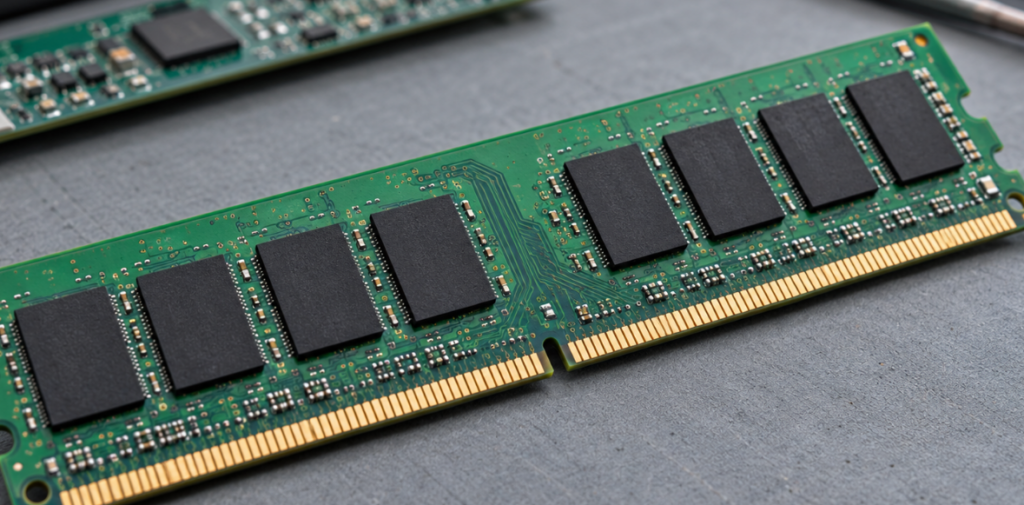
Electrically erasable programmable read-only memory allows stored data to be updated electrically. Typical applications include calibration values, serial numbers, configuration settings, and operating counters.
Serial EEPROMs commonly use I²C, SPI, or Microwire interfaces. Many support byte writes and page writes, making them useful for relatively small records that change occasionally.
Page behavior deserves a closer look when approving an alternate. In Microchip’s 24AA256/24LC256/24FC256 datasheet, page writes must stay inside a 64-byte physical page. Crossing the boundary wraps the address within that page and can overwrite earlier bytes. Other EEPROMs have different page sizes or behavior.
Compare write-cycle time, addressing, write protection, supply range, and endurance as well as capacity. Firmware must wait for completion in the way the selected device requires.
An operating counter that updates continuously can consume EEPROM endurance faster than an infrequently changed calibration record. Engineers should estimate writes to each location over the product’s intended service life and decide whether record rotation or another memory technology is needed.
For purchasing, ask for the full ordering code. A familiar family prefix does not establish compatibility across voltage, package, temperature, or interface variants.
Flash Memory: NOR vs. NAND
Flash is an electrically programmable non-volatile memory technology. Unlike typical byte-update EEPROM usage, Flash generally requires erasing a sector or block before reprogramming it. NOR and NAND organize access differently, which affects both hardware and firmware.
NOR Flash
NOR is widely used for boot code and firmware. It supports random reads, and suitable NOR devices and host controllers can support execute-in-place, where the processor runs code without first copying it into RAM.
Serial NOR is common in embedded systems. Buyers should check command compatibility, address length, supported bus modes, erase sizes, protection settings, reset behavior, and operating voltage.
A larger-capacity NOR device may require a different addressing mode. That change can prevent a board from booting if its boot ROM or firmware cannot access the part correctly.
NAND Flash
NAND is widely used when a system needs larger storage capacity. It typically reads and programs data in pages and erases blocks. NAND appears in raw memory ICs and managed products such as eMMC and SSDs.
Raw NAND requires the system to accommodate its error-correction and bad-block requirements. Error-correcting code, or ECC, detects and corrects errors within its supported limits. Some devices include internal ECC or other management features; the division of responsibility depends on the exact part.
Managed NAND combines NAND with a controller that handles important storage-management tasks internally. A raw NAND chip and an eMMC device therefore represent different integration choices.
| Comparison | NOR Flash | NAND Flash |
|---|---|---|
| Common application | Boot code and firmware | Larger code and data storage |
| Read behavior | Random reads; XIP possible with suitable hardware | Typically page-based access |
| Erase behavior | Sector or block erase | Block erase |
| Main integration check | Commands, addressing, protection, boot support | Page geometry, ECC, bad-block management |
| Replacement review | Hardware and firmware compatibility | Controller and storage-software compatibility |
These are general patterns, and product-specific features can differ. Micron’s overview of NOR and NAND Flash explains their common application roles.
For NAND, also identify the cell type where relevant: SLC, MLC, TLC, or QLC. Those descriptions refer to how many bits each cell stores. Do not transfer an endurance or retention figure from one device to another based only on that label.
Other Memory Types: FRAM and MRAM
FRAM
Ferroelectric random-access memory, also called F-RAM or FeRAM, stores data using ferroelectric polarization. It retains information without power and offers fast writes and high endurance in specified devices.
FRAM can be useful for frequently updated counters, event records, and state information. It avoids the conventional Flash erase-before-program workflow, but the application’s transaction-completion requirements still need review.
A serial FRAM may look similar to an EEPROM and use the same bus. That does not establish compatibility. Compare addressing, commands, pin functions, protection, timing, and power-up and power-down requirements.
Infineon’s FM24V02A product information illustrates why retention and endurance should be read with their stated conditions. A specification for one FRAM device should not become a blanket claim for the technology.
MRAM
Magnetoresistive random-access memory stores information using magnetic states. It is non-volatile and can provide fast read and write operation with high endurance, depending on the product family.
MRAM can suit persistent buffers and frequently updated system records. Different MRAM technologies and interfaces serve different performance and density requirements.
For qualification, compare retention at the intended temperature, endurance, access timing, interface behavior, and any stated environmental limits. Engineering should validate a proposed replacement in the actual system.
FRAM and MRAM show why “RAM” does not always mean volatile memory. Their retention behavior must be identified from the technology and datasheet, rather than the name alone.
Fazit
The main types of memory ICs serve different storage needs. SRAM and DRAM handle working data; ROM, PROM, and EPROM support fixed or legacy program storage; EEPROM stores small updateable records; and NOR and NAND Flash cover firmware and larger storage requirements. FRAM and MRAM provide further options for frequently updated data that must survive power removal.
A purchasing decision should preserve the approved memory type, complete part number, capacity, organization, interface, voltage, temperature grade, and programming requirements. Any alternate also needs engineering approval. DuoLink’s BOM procurement guide explains how to carry those requirements into a sourcing inquiry.
DuoLink Electronics is an independent electronic-component supplier offering IC sourcing and BOM quotation support. To discuss a memory IC requirement, contact DuoLink with the manufacturer part number, quantity, delivery target, application, and any programming, date-code, packaging, or documentation needs. Confirm availability and the evidence available for the quoted lot before placing the order.
Häufig gestellte Fragen
Which types of memory ICs retain data when power is removed?
ROM, PROM, EPROM, EEPROM, NOR Flash, NAND Flash, FRAM, and MRAM are non-volatile. Check the exact device’s retention conditions and the system’s behavior if power disappears during a write.
Are DDR and SDRAM different from DRAM?
They are members of the DRAM family. SDRAM synchronizes operation with a clock, while DDR SDRAM transfers data on both clock edges. Generations have different controller and electrical requirements.
Can Flash replace EEPROM?
It can in an approved redesign, but it is not a general drop-in replacement. Compare erase granularity, endurance, write timing, interface, and firmware changes needed to preserve existing records.
Can NOR Flash and NAND Flash be interchanged?
Generally, they cannot. Access organization, commands, controller requirements, and error management differ. Matching capacity or package does not establish compatibility.
How do I confirm a replacement memory IC is compatible?
Compare the full datasheets for voltage, pinout, organization, interface, timing, commands, and temperature grade. Engineering should also check boot behavior and validate operation on the target board.


 German
 English
 Spanish
 French
 Chinese
 Italian