
A resistor is one of the simplest parts on a circuit board, but choosing one is not always simple.
Its basic job is easy to understand: a resistor controls the flow of electric current by adding resistance to a circuit. Once you move from a schematic to a real product, more questions appear. How much power can the resistor safely handle? Will its resistance drift when the board gets hot? Is a 0603 resistor suitable just because the resistance value matches? Can you replace a thick film resistor with a thin film part?
These questions matter in design, production, and component sourcing.
From my experience working with electronic component purchasing, resistor selection errors often come from looking at only three items: resistance value, tolerance, and package. A complete check should go deeper. Power rating, temperature coefficient, maximum working voltage, pulse capability, resistor technology, and the exact manufacturer part number can all change whether a part is suitable for the circuit.
This guide explains what a resistor is, how different resistor types work, where they are used, and what you should check before selecting or sourcing one. For the board-level context, our overview of common PCB components shows how resistors fit alongside capacitors, inductors, semiconductors, and other device families.
1. What Is a Resistor?
A resistor is a passive electronic component that provides a defined amount of electrical resistance.
Resistance is measured in ohms, written with the symbol Ω. You will also see values expressed in kilohms (kΩ) and megohms (MΩ).
Unlike a transistor or integrated circuit, a standard fixed resistor does not actively amplify or switch a signal. It responds to the voltage and current already present in the circuit. Electrical energy that the resistor dissipates becomes heat.
This simple behavior gives engineers a useful way to control current, set voltage levels, establish transistor bias points, create feedback networks, sense current, and protect other components. Panasonic describes current control, voltage division, current detection, and biasing as four basic resistor roles.
How Does a Resistor Work?
Think of current as electrical charge moving through a conductor. A resistor makes that movement more difficult.
A higher resistance usually allows less current to flow when the applied voltage stays the same. A lower resistance allows more current.
The resistor itself must also deal with the energy created by this process. If too much power is dissipated, the part can become excessively hot. Its resistance may drift, the surrounding PCB can heat up, or the component can eventually fail.
This is why resistance value alone never gives you enough information to select a resistor.
Understanding Resistance and Ohm’s Law
The basic relationship between voltage, current, and resistance is described by Ohm’s Law:
V = I × R
Where:
- V = voltage in volts
- I = current in amperes
- R = resistance in ohms
You can rearrange the formula:
I = V / R
R = V / I
Power also needs to be checked:
P = V × I
Using Ohm’s Law, you can also calculate:
P = I²R
or:
P = V² / R
These equations give you the theoretical electrical requirement. The selected resistor still needs enough thermal, voltage, and pulse capability for the real operating environment.
2. What Are the Main Functions of a Resistor?
A resistor does more than simply “reduce electricity.” Its function depends on where it sits in the circuit and what surrounds it.
Limiting Current
Current limiting is one of the most familiar resistor applications.
An LED, transistor input, optocoupler, or other device may need its current kept below a certain level. A resistor placed in the current path creates the required voltage drop and limits the current.
The resistance value controls how much current flows, but the resistor’s power rating determines whether it can deal with the heat created while doing that job.
This distinction is easy to miss.
A resistor can have the correct resistance and still be unsuitable because its wattage or pulse rating is too low.
Dividing and Controlling Voltage
Two or more resistors can form a voltage divider.
For two resistors:
Vout = Vin × R2 / (R1 + R2)
Voltage dividers appear in feedback circuits, ADC inputs, reference circuits, measurement systems, and power supply control networks.
The ratio between the resistor values is often more important than the individual values.
You also need to consider the load connected to the divider. Once another circuit draws current from the output node, the effective resistance changes. The real output voltage may no longer match the simple unloaded calculation.
For precision divider circuits, resistor tolerance and temperature coefficient deserve close attention. Vishay’s technical material shows how tolerance and TCR directly influence resistor network accuracy and stability.
Biasing, Pull-Up, and Pull-Down Applications
Digital and analog circuits often need a known voltage state.
A pull-up resistor connects a signal toward the positive supply. A pull-down resistor connects it toward ground. These resistors keep inputs from floating when no device is actively driving the signal.
Bias resistors serve another purpose. They establish operating conditions for transistors, amplifiers, sensors, and other active components.
The key is not simply choosing a common value such as 10 kΩ. You need to understand input leakage, switching speed, power consumption, noise sensitivity, and the voltage level required by the connected device.
3. What Are the Different Types of Resistors?
There is no single resistor construction that works best for every circuit.
The resistor technology affects precision, noise, temperature stability, pulse performance, power handling, size, and long-term resistance drift.
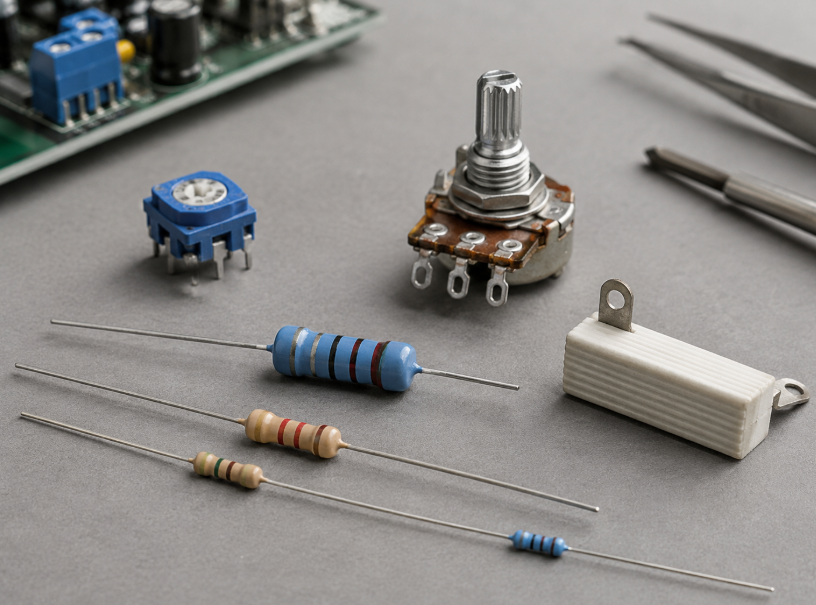
Fixed Resistors
Fixed resistors have a nominal resistance value that is not designed for normal user adjustment.
| Resistor Type | Main Characteristics | Common Uses |
|---|---|---|
| Thick Film | Compact, widely available, broad resistance range | General PCB circuits, pull-ups, voltage dividers |
| Thin Film | Tight tolerance, low TCR, better stability | Precision analog, instrumentation, feedback circuits |
| Metal Film | Good accuracy and stability, commonly available in leaded packages | Measurement, audio, control circuits |
| Wirewound | Handles higher power and surge energy well | Power supplies, industrial equipment, braking and load circuits |
Thick Film Resistors
Thick film technology is widely used for general-purpose chip resistors.
These parts fit many designs where extreme precision is not required. You can find them across a wide resistance range and in common SMD packages such as 0402, 0603, 0805, and 1206.
For high-volume boards, thick film resistors often cover a large part of the BOM.
Do not assume all thick film parts with the same package and resistance are interchangeable. Their TCR, pulse rating, voltage rating, operating temperature, termination construction, and reliability specifications may differ.
Thin Film Resistors
Thin film resistors are usually selected when accuracy and stability matter more.
They can offer tighter resistance tolerance and lower TCR than many general-purpose thick film parts. This makes them useful in precision voltage dividers, instrumentation amplifiers, measurement circuits, signal conditioning, and feedback networks. Vishay identifies precision voltage dividers, converters, instrumentation amplifiers, and measurement bridges among typical thin-film applications.
Metal Film Resistors
Metal film resistors are common in leaded designs that require good accuracy, low noise, and stable electrical characteristics.
They appear in control equipment, measurement products, analog circuits, audio electronics, and older through-hole PCB designs.
Their exact performance still depends on the product series, so “metal film” should not be treated as a complete specification.
Wirewound Resistors
A wirewound resistor uses resistance wire wound around an insulating core.
This construction can handle substantial power and energy, which makes wirewound parts useful in power and industrial circuits.
One issue needs attention: the wound wire can add inductance. That may be undesirable in high-frequency or fast-switching circuits. Non-inductive wirewound designs exist for applications where this behavior must be reduced.
Variable Resistors
Variable resistors allow the resistance or voltage division ratio to be adjusted.
Potentiometers
A potentiometer normally has three terminals and works as an adjustable voltage divider.
You will find potentiometers in control interfaces, calibration circuits, audio equipment, power controls, and sensor adjustment systems.
Rheostats
A rheostat normally uses two active terminals and controls current by changing resistance.
They are less common in compact modern electronics but still appear in control, test, educational, and higher-power applications.
Trimmer Resistors
Trimmer resistors are small adjustable components intended mainly for circuit calibration.
They are often adjusted during manufacturing, testing, maintenance, or initial setup rather than by the end user.
Special-Purpose Resistors
Some resistor-based components intentionally change their resistance in response to physical conditions or perform a more specialized electrical function.
Thermistors
A thermistor changes resistance as temperature changes.
NTC thermistors decrease in resistance as temperature rises. PTC thermistors increase in resistance over their defined operating behavior.
They are widely used for temperature measurement, temperature compensation, inrush-current control, and protection.
Photoresistors
A photoresistor, often called an LDR, changes resistance according to light intensity.
It can be used in light detection, automatic lighting controls, and simple optical sensing circuits.
Current-Sense Resistors
Current-sense resistors are usually very low-value resistors used to measure current.
The circuit measures the small voltage drop across the resistor and calculates current from Ohm’s Law.
Low resistance alone is not enough here. Tolerance, TCR, power rating, thermal behavior, terminal construction, and PCB connection method can directly affect measurement accuracy.
Power Metal Strip and similar shunt technologies are designed for these applications and are commonly used in power supplies, battery systems, converters, and automotive controls.
You can review common resistor product types and part specifications when comparing fixed, precision, power, and current-sense resistor requirements.

4. SMD Resistors vs. Through-Hole Resistors
SMD and through-hole resistors perform the same basic electrical job, but their mechanical structure and assembly method are different.
SMD resistors mount directly onto PCB pads. They support compact board layouts and automated assembly.
Through-hole resistors use leads inserted through holes in the PCB. They take more board space but can be useful when mechanical strength, manual assembly, high power, special construction, or easier servicing matters.
SMD Resistor Sizes and Common Packages
Common chip resistor package codes include:
| Package | Approx. Body Size | Typical Design Reason |
|---|---|---|
| 0201 | 0.6 × 0.3 mm | Very high PCB density |
| 0402 | 1.0 × 0.5 mm | Compact consumer and portable electronics |
| 0603 | 1.6 × 0.8 mm | Good balance between size and assembly |
| 0805 | 2.0 × 1.25 mm | More thermal area and easier handling |
| 1206 | 3.2 × 1.6 mm | Higher-power or more robust designs |
These dimensions are useful as a general reference. Always confirm the mechanical drawing in the manufacturer’s datasheet.
Package size does not guarantee a fixed power rating. Different resistor technologies can provide different power ratings in the same nominal footprint.
When to Use Through-Hole Resistors
Through-hole resistors still make sense when the design needs higher power, stronger mechanical mounting, easy manual replacement, special voltage spacing, or resistor constructions that are not practical in very small SMD packages.
They also remain common in industrial equipment, power electronics, maintenance products, prototypes, and legacy assemblies.
The mounting format should follow the electrical and mechanical requirements of the board, not simply the age of the technology.
5. What Resistor Specifications Should You Know?
This is the area where resistor selection becomes more than choosing an ohm value.
| Specification | What It Tells You | Why It Matters |
|---|---|---|
| Resistance | Nominal opposition to current | Sets circuit current or voltage ratio |
| Tolerance | Allowed initial resistance variation | Affects circuit accuracy |
| Power Rating | Continuous heat dissipation capability | Prevents thermal overstress |
| TCR | Resistance change with temperature | Affects stability and measurement accuracy |
| Working Voltage | Maximum allowed continuous voltage | Prevents electrical overstress |
| Operating Temperature | Allowed temperature range | Affects reliability and derating |
| Pulse Rating | Short-duration energy capability | Important for surge and switching circuits |
Resistance Value and Tolerance
A 10 kΩ resistor with ±1% tolerance does not mean every part measures exactly 10,000 Ω.
Its initial value may fall within the specified tolerance range.
For many digital pull-up circuits, ±1% may already be more than sufficient. Precision amplifiers, reference networks, sensing circuits, and measurement systems may need much tighter values.
Tolerance describes initial accuracy. It does not tell you how much resistance can change with temperature or aging.
That distinction matters.
Power Rating
Power rating describes how much electrical power a resistor can dissipate under defined conditions.
A resistor marked or specified as 0.1 W should not automatically be operated continuously at exactly 0.1 W under every board condition.
Ambient temperature, PCB copper area, airflow, neighboring heat sources, mounting method, enclosure temperature, and manufacturer derating rules all influence real thermal performance.
Manufacturer datasheets commonly specify power derating above a defined ambient temperature. Panasonic also notes that resistor temperature and surrounding PCB conditions need to be checked even when the electrical load remains within the nominal rating.
For a production design, leaving thermal margin is usually better than designing directly against the published limit.
Temperature Coefficient
Temperature coefficient of resistance, or TCR, tells you how much the resistance may change when temperature changes.
It is commonly expressed in ppm/°C.
A lower absolute TCR usually gives better resistance stability across temperature.
This becomes important in:
- precision voltage dividers
- current sensing
- ADC input networks
- instrumentation
- voltage references
- feedback circuits
A resistor can have a very tight initial tolerance and still move enough with temperature to affect circuit accuracy.
Maximum Working Voltage
Power rating and maximum working voltage are separate limits.
For many resistor series, the permitted continuous voltage is related to:
V = √(P × R)
The datasheet may also specify a limiting element voltage. The actual permitted voltage is normally restricted by whichever applicable limit is lower.
Panasonic resistor documentation uses this relationship and separately defines limiting element voltage for relevant product families.
This becomes easy to overlook with high resistance values. A resistor may dissipate little power but still see a voltage higher than its permitted working voltage.
Pulse and overload voltage ratings need separate checks when the circuit experiences short transients.
6. What Are Resistors Used for? Common Applications
You can find resistors in almost every type of electronic equipment, but the requirements change greatly from one circuit to another.
Power Supplies and Voltage Regulation
Power circuits use resistors for feedback networks, current measurement, startup paths, discharge paths, gate control, voltage sensing, and compensation networks.
The resistance value may be only the starting point.
A feedback resistor may need good long-term stability and low TCR. A current-sense resistor may need low resistance and high power capability. A startup resistor may need enough working voltage and pulse capability.
LED and Current-Limiting Circuits
A resistor can set the current through an LED when the supply and LED forward voltage are known.
The required resistance can be estimated with:
R = (Vsupply − VLED) / ILED
The resistor’s power dissipation should then be calculated and checked against the selected part’s rating.
For LED strings or higher-power lighting, temperature changes and supply variation also need attention. A simple room-temperature calculation may not represent the worst operating condition.
Sensors and Measurement Circuits
Measurement circuits are much less forgiving of resistor drift.
Precision resistors may form Wheatstone bridges, amplifier gain networks, voltage dividers, current shunts, sensor bias networks, or ADC input circuits.
Here, tolerance, TCR, noise, self-heating, long-term stability, and resistance matching can matter as much as nominal resistance.
For current sensing, PCB layout can even become part of the measurement system. Very low-value shunts may use Kelvin connections so voltage is measured separately from the high-current path.
Automotive, Industrial, and Consumer Electronics
Automotive electronics use resistors in battery management, motor control, power conversion, ECUs, sensing circuits, lighting, infotainment, and safety-related systems.
If an automotive project requires qualified components, check the qualification of the exact MPN rather than assuming every resistor in the same family carries the same status. You can see the broader component requirements involved in automotive electronic applications.
Industrial equipment creates a different set of demands. Motor drives, PLCs, control boards, inverters, power supplies, and sensor systems may expose resistors to heat, vibration, surge events, and long operating hours. Component selection for industrial automation applications should account for these operating conditions rather than relying only on nominal circuit values.
Consumer electronics often place more pressure on board size and power efficiency, which is one reason small SMD resistor packages are so common.
7. How to Choose the Right Resistor for Your Circuit
Start with the circuit requirement, then work toward the part number.
Do not start with an available resistor and try to make the design fit around it.
Calculate the Required Resistance
Use the circuit voltage, current, gain, bias, sensing, or divider requirement to determine the target resistance.
Then check whether the calculated value should use a standard resistor value or a more precise E-series value.
The electrical calculation tells you the nominal resistance. It does not complete the selection.
Check Power, Tolerance, and Temperature Requirements
Calculate normal power dissipation and examine worst-case conditions.
Ask:
- What happens at the maximum supply voltage?
- What is the highest expected ambient temperature?
- Does the resistor need power derating?
- Does the circuit experience surge or pulse loads?
- How much resistance error can the circuit tolerate?
- How much drift with temperature is acceptable?
For a precision circuit, tolerance and TCR should be reviewed together.
For a power circuit, continuous wattage and pulse capability should be reviewed separately.
Consider Package Size and Mounting Type
Choose a package that works electrically, thermally, and mechanically.
A smaller resistor saves board space, but it can reduce thermal area and make assembly or inspection more demanding.
A larger resistor is not always necessary either. Modern resistor technologies can offer substantial performance in compact packages.
Use the manufacturer’s exact datasheet instead of assuming performance from the footprint.
Verify the Manufacturer Part Number Before Sourcing
This is one of the most important steps from a purchasing perspective.
Do not approve a resistor based only on a description such as:
10 kΩ, 1%, 0603
That leaves out too much information.
Before placing an RFQ or approving an alternative, check:
- manufacturer
- full manufacturer part number
- resistor technology
- nominal resistance
- tolerance
- TCR
- package
- power rating
- maximum working voltage
- pulse requirements
- operating temperature
- termination type
- required qualification
- packaging format
- compliance requirements
- traceability requirements
For products entering regulated markets, material compliance may also need to be checked. The European Commission’s official RoHS information explains restrictions on hazardous substances in electrical and electronic equipment.
For REACH-related purchasing requirements, buyers can review the current ECHA Candidate List of substances of very high concern.
RoHS or REACH documentation does not tell you whether a resistor is electrically suitable for your design. Treat material compliance, electrical performance, reliability requirements, and part traceability as separate checks.
When an alternate MPN is proposed, compare the complete datasheets rather than matching only resistance, wattage, and footprint.
Conclusion
A resistor looks simple because its basic electrical behavior is simple. Selecting the right resistor takes more thought.
Start with resistance value and Ohm’s Law, then look at the conditions surrounding the part. Tolerance controls initial accuracy. TCR affects resistance across temperature. Power rating relates to heat. Working voltage places another electrical limit on the part. Pulse capability, package, resistor technology, mounting style, and qualification can become just as important in demanding circuits.
For sourcing, the core question is not “Can I find another 10 kΩ resistor?”
The better question is: Does the proposed part meet the same electrical, thermal, mechanical, reliability, and compliance requirements as the original MPN?
If you are sourcing electronic components, Duolink Electronics is an independent electronic component supplier covering integrated circuits, semiconductors, passive components, connectors, and related electronic parts. We support BOM sourcing, part-number checks, inventory searches, and hard-to-find component procurement.
If you need resistors or other electronic components for an existing BOM, new design, or replacement requirement, you can contact our team through the website and send the required manufacturer part numbers for review.
Frequently Asked Questions
Can I replace a resistor with another brand if the resistance and package are the same?
Not automatically. Compare tolerance, TCR, power rating, working voltage, pulse capability, operating temperature, technology, dimensions, termination, and any required qualification before approving a substitute.
What information should I include when sending a resistor RFQ?
Provide the full manufacturer part number, required quantity, preferred manufacturer, acceptable alternatives, package requirement, compliance needs, and any date-code or traceability requirements. Exact MPNs reduce sourcing errors.
Why does an SMD resistor have no resistance code printed on it?
Very small SMD resistors often have no readable marking because there is not enough surface area. Identify these parts through the manufacturer part number, BOM, reel label, package information, and datasheet rather than relying on visual markings.
Can I use a resistor with a higher power rating than the original?
It may be possible, but wattage alone does not determine compatibility. Check package dimensions, resistance tolerance, TCR, working voltage, pulse performance, parasitic behavior, PCB layout, and qualification before making the change.
What should I check when sourcing precision or current-sense resistors?
Pay close attention to tolerance, TCR, resistance stability, power handling, thermal performance, terminal construction, and the exact resistance range. For low-ohm current-sense parts, even PCB connection and sensing layout can affect measurement accuracy.
Is RoHS compliance enough to confirm that a resistor is suitable?
No. RoHS addresses restricted substances. It does not confirm resistance accuracy, power capability, voltage rating, temperature performance, automotive qualification, or circuit compatibility. Electrical and compliance requirements should be verified separately.


 English
  German
  Spanish
  French
  Chinese
  Italian