Choosing an electronic component distributor in China is not just a search for stock. You are choosing a supply-chain path. That path affects authenticity, lead time, traceability, packaging, compliance documents, and what happens when a part fails incoming inspection.
From a buyer’s view, the first question should not be, “Who has the lowest quote?” Ask, “Which distributor type fits this part, this quantity, and this risk level?” A prototype order for standard resistors has a very different risk profile from an obsolete microcontroller used in industrial equipment. The right distributor for one may be the wrong distributor for the other.
The 15 companies below are not presented as a strict revenue ranking. They are selected for their relevance to buyers sourcing in or through China, including global authorized distributors, Asia-based distribution groups, digital catalog suppliers, local distributors, and independent specialists.
Why Choose an Electronic Component Distributor in China?
A Complete and Mature Electronics Supply Chain
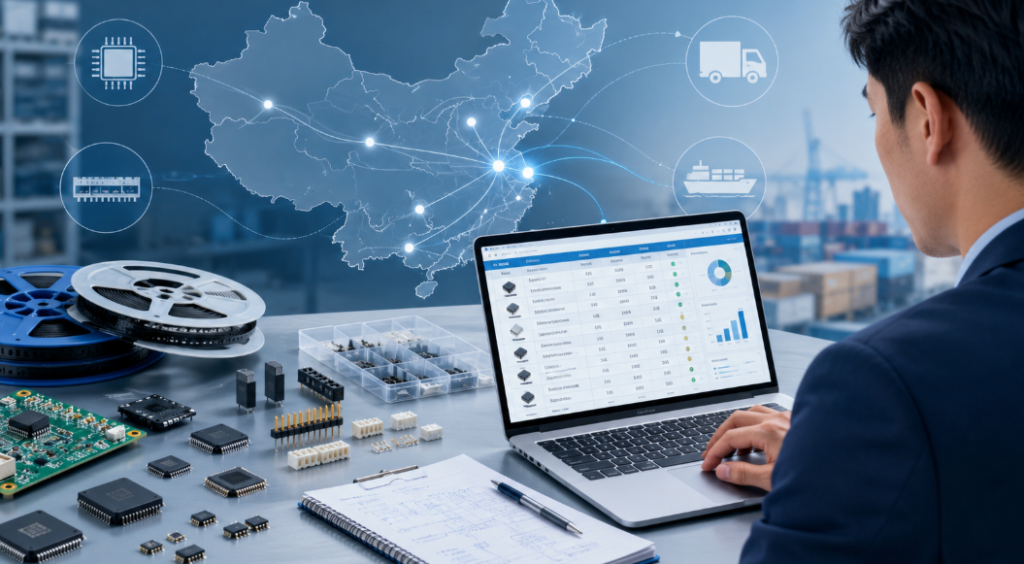
China has dense electronics clusters that connect component trading, PCB fabrication, assembly, testing, tooling, cable production, logistics, and export services. Shenzhen and Hong Kong remain major sourcing and trading centers. Shanghai, Suzhou, and the wider Yangtze River Delta support automotive, industrial, computing, and high-volume manufacturing. Beijing and Tianjin have strong communication, research, and system-design activity. Chengdu and Chongqing add semiconductor, display, automotive, and industrial capacity.
This density helps when a BOM contains mixed categories. A buyer may need an MCU, power ICs, oscillators, relays, passives, and several connector families in one shipment. A capable Electronic Component Distributor can consolidate those lines, check packaging requirements, and reduce the number of separate deliveries your factory must receive.
Better Sourcing Economics
The real advantage is not a cheap unit price. It is the ability to compare several supply paths close to the manufacturing base.
A China-based distributor may have access to local manufacturer stock, Asia allocation, excess inventory, regional franchised channels, or open-market sources. This can improve the total procurement result when you include freight, split shipments, production delays, inspection work, and the cost of buying the wrong revision.
Be careful here. A very low quote with no source explanation is not an advantage. It is an unanswered question.
Flexible Lead Times and Wider Component Choice
China’s distributor market supports small prototype orders, scheduled production releases, BOM consolidation, shortage sourcing, and obsolete-part searches. The flexibility comes from channel variety.
Authorized distributors are usually the first choice for active parts, planned production, technical support, and manufacturer traceability. Independent distributors become useful when allocation, end-of-life status, regional stock imbalance, or a factory deadline makes the authorized path unavailable.
The core point is simple: flexibility should never mean weak controls.

Overview of China’s Electronic Component Distribution Market
Current Market Structure
The market is no longer divided into only “big distributors” and “small traders.” Buyers now deal with several models:
| Distributor model | Best fit | Main buyer check |
|---|---|---|
| Global authorized distributor | New designs, active parts, scheduled production | Confirm the exact manufacturer franchise and sales territory |
| Asia-focused authorized or value-added distributor | OEM programs, local engineering support, regional supply | Check line card, FAE support, allocation rules, and local warehouse scope |
| Digital catalog distributor | Prototypes, maintenance, small and mixed orders | Check stock location, packaging, country of origin, and return terms |
| Independent distributor | Shortage, excess stock, obsolete and hard-to-find parts | Require source disclosure, inspection records, traceability, and an agreed test plan |
| Marketplace or trading platform | Broad search and supplier discovery | Verify the actual seller; do not treat platform inventory as distributor-owned stock |
Authorized Distributors vs. Independent Distributors
An authorized distributor has a formal agreement with a manufacturer for defined product lines, regions, or customer groups. This channel usually gives you the strongest chain of custody, manufacturer-backed documentation, and access to application support.
An independent IC Distributor is not tied to one manufacturer’s franchise network. It can search a wider market, including excess stock, regional inventory, discontinued parts, and stock held by other approved sources. That reach can solve real production problems. It also adds source risk.
I do not judge a supplier only by the word “authorized” or “independent.” I judge the transaction. Who owns the stock? Where is it stored? Is the stock in original factory packaging? Are date and lot codes available? Can the seller provide real photos before shipment? What inspection has already been completed? Will the purchase order state the agreed authenticity and return conditions?
Main Electronic Component Clusters in China
Shenzhen and Hong Kong are the strongest centers for component trading, export handling, rapid BOM searches, and open-market inventory. The Yangtze River Delta is often a better fit for structured OEM and EMS supply programs. Beijing and Tianjin support communication, aerospace-related, research, and industrial projects. Chengdu and Chongqing are useful for buyers connected to western China’s manufacturing base.
Location alone does not prove quality. A Shenzhen office can belong to a major global distributor, a skilled independent supplier, or a one-person broker with no physical stock. Your audit must identify which one you are dealing with.
Top 15 Electronic Component Distributors in China
International and Large Authorized Distributors
Arrow Electronics
Arrow is a broad global distributor with electronic component operations and offices in China. It is a strong fit for OEMs and EMS companies that need manufacturer line coverage, engineering support, lifecycle data, and supply-chain services. Buyers should confirm that the requested manufacturer and part family fall under Arrow’s authorization for the relevant territory.
Avnet
Avnet serves design and production customers through a wide semiconductor and electronic component portfolio. Its value is strongest when sourcing is linked to engineering work, embedded solutions, or planned manufacturing demand. For passive, interconnect, and electromechanical lines, review the current APAC line card rather than assuming every global franchise applies to mainland China.
WPG Holdings
WPG is a major Asia-Pacific semiconductor distribution group. It is relevant to high-volume OEM programs, regional design support, and supply-chain coordination across Greater China and Asia. The holding structure includes multiple distribution businesses, so the buyer should identify the actual contracting entity, authorized line, warehouse, and service team behind the quotation.
WT Microelectronics and Future Electronics
WT Microelectronics is a large semiconductor distributor with deep Asia coverage. It completed its acquisition of Future Electronics in 2024, creating a broader global distribution group. Buyers may encounter different commercial teams and systems, so confirm which entity is quoting, where the stock is held, and which quality terms will appear on the order.
Macnica
Macnica is known for technology-led distribution and engineering support. Its China-facing operations are useful for buyers who need more than a stock check, such as design guidance, solution development, programmable logic, networking, sensors, or advanced semiconductor support. It is a good candidate when the part choice is still open and engineering input can reduce redesign risk.
TTI
TTI specializes in interconnect, passive, electromechanical, and discrete components. That focus matters. Buyers sourcing connectors, relays, capacitors, resistors, protection devices, and related lines may receive deeper category support than from a distributor built mainly around ICs. TTI also has China operations and a long-standing authorized distribution model.
Mouser Electronics
Mouser is a factory-authorized digital distributor used heavily for new product introduction, prototypes, engineering samples, and mixed small-quantity orders. Its parametric search and broad catalog help engineers compare parts quickly. For production buying, check packaging quantity, stock location, replenishment lead time, and whether all BOM lines can ship in the same window.
DigiKey
DigiKey is a globally authorized catalog distributor with a China-facing website. It is well suited to prototypes, maintenance, engineering evaluation, and low-to-medium mixed orders. Buyers should review customs, import handling, packaging, and stock origin before assuming a website delivery date is the same as a factory-ready date.
Rutronik
Rutronik is a franchised broadline distributor with offices in Shenzhen, Shanghai, Chengdu, Tianjin, Hong Kong, and other Asian locations. It covers semiconductors, passives, electromechanical products, storage, wireless, and embedded technologies. It can be a strong fit for industrial and automotive projects that need local technical contact and cross-region support.
RS
RS combines electronics, automation, control, tools, and maintenance products. It is useful when the purchasing list extends beyond board-level components into sensors, relays, power supplies, test equipment, ESD products, and factory consumables. For pure semiconductor production programs, compare its line depth and packaging options with a semiconductor-focused distributor.
Well-Known Local and Asia-Based Distributors
LCSC Electronics
LCSC is a Shenzhen-based digital distributor with a large in-stock catalog. It is popular for prototypes, small production runs, passives, connectors, and parts from many Chinese manufacturers. Authorization can vary by brand. Check the product page, manufacturer channel information, packaging, and traceability rather than treating the entire catalog as one uniform source type.
Weikeng
Weikeng provides semiconductor and electronic component distribution across memory, power devices, microcontrollers, processors, connectors, programmable logic, and passives. Its value is the one-stop regional model. Buyers should still verify the current manufacturer line card, the legal selling entity, and whether the quote is franchised stock or sourced through a wider network.
Yitoa
Shenzhen-listed Yitoa operates in electronic component distribution and semiconductor-related businesses. It can be relevant for buyers seeking China-based line coverage and local market access. Since the group has several business units and product activities, ask for the exact authorization letter or manufacturer confirmation tied to the requested brand.
Distributors Focused on Shortage, Obsolete, and Special Components
Fusion Worldwide
Fusion Worldwide is an independent distributor with operations in Shenzhen and other global locations. Its model is designed for open-market sourcing, shortages, excess inventory, cost-reduction searches, and obsolete parts. This is a channel where the test plan matters as much as the quote. Define inspection level, sample approval, traceability, and rejection rights before shipment.
WIN SOURCE
WIN SOURCE is an independent distributor with roots and operations in Shenzhen and a focus that includes common, obsolete, and hard-to-find parts. Buyers considering open-market stock should request live inventory confirmation, original photos, date and lot information, source classification, and test scope. Do not approve a shortage order from a database line alone.
Criteria for Selecting a Top Electronic Component Distributor
Product Lines, Authorization, and Inventory Capability
A long line card is not enough. Check whether the distributor is authorized for the exact manufacturer, product family, and territory. Ask whether the stock is owned, allocated, inbound, or subject to supplier confirmation.
For a BOM, send clean data:
- Full manufacturer part number
- Manufacturer name
- Required quantity and acceptable split quantity
- Package and mounting type
- Minimum date-code requirement, when justified
- RoHS or other material requirements
- Required delivery date and ship-to country
- Whether alternatives are allowed
- End application and lifecycle expectation
This information lets the distributor separate an exact match from a possible substitute. It also prevents wasted time on incomplete IC Distributor quotations.
Product Quality and Component Traceability
Traceability is not one document. It is a chain of evidence. Depending on risk, it may include the original manufacturer label, distributor packing label, lot and date code, country of origin, certificate of conformance, packing list, purchase history, and source declaration.
For high-reliability products, build the traceability level into the purchase order. The IPC-1782 supply-chain traceability framework gives buyers and suppliers a useful basis for agreeing how much traceability the application needs. A certificate is not a replacement for part-level evidence.
Quotation Quality, Lead Time, and Customer Service
A strong quotation should answer more than quantity and delivery. It should identify manufacturer, exact part number, condition, packaging, stock location, lead-time basis, date code if available, warranty or return limits, shipping term, and quote validity.
Watch how the sales team handles uncertainty. A reliable supplier says “subject to warehouse confirmation” when stock has not been physically checked. A weak supplier calls every database result “in stock.”
Service quality also appears after the order. Ask who manages nonconforming material, what evidence is needed for an RMA, and how quickly the supplier must be notified after receipt.
How to Choose the Right Chinese Electronic Component Distributor
Match the Distributor to Quantity and Component Type
Use authorized digital distributors for prototypes and active parts when the product is available. Use broadline or value-added distributors for planned OEM production, design support, and scheduled releases. Use an independent Electronic Component Distributor when the normal channel is blocked by shortage, regional allocation, or end-of-life status.
For commodity passives, connector families, and common discrete devices, local catalog distributors can be efficient. For safety-related power semiconductors, automotive parts, medical equipment, aerospace systems, or high-value ICs, raise the evidence and testing level.
| Requirement | Preferred starting channel | Extra control |
|---|---|---|
| Prototype or engineering sample | Authorized catalog distributor | Confirm package, revision, and stock location |
| Repeat production | Authorized or franchised distributor | Schedule releases and review lifecycle notices |
| Mixed BOM with many categories | Broadline or BOM sourcing supplier | Approve alternatives line by line |
| Shortage or obsolete IC | Qualified independent IC Distributor | Source review, photos, sample test, enhanced inspection |
| Regulated or high-reliability use | Manufacturer-approved channel where possible | Full traceability, quality agreement, application-based test plan |
Verify Company Status, Authorization, and Quality Certifications
Start with the legal company name. Match it across the quotation, invoice, bank beneficiary, website, and business registration. A polished website does not solve a mismatch between the seller and the payment account.
For authorization, check the component manufacturer’s distributor locator or request a current authorization letter. Read its scope. Some letters apply only to a country, product line, or affiliated entity.
Quality certification should also be checked by scope and issuing body. The ISO 9001 quality management standard describes a management system; it does not prove that every component is genuine. Ask whether the certified scope covers electronic component distribution, warehousing, inspection, or testing.
Compare MOQ, Commercial Terms, and After-Sales Policy
MOQ should match the actual packaging and channel. A supplier may need to sell a full reel, tray, tube, or factory pack even when your production demand is lower. Ask whether the quantity is a manufacturer pack, distributor pack, or repacked quantity.
Review cancellation rules, non-cancellable and non-returnable terms, claim windows, warranty language, payment beneficiary, Incoterms, freight responsibility, and customs documents. Do this before placing the purchase order. A good quote can become a poor order when these terms are left open.
Precautions When Sourcing Electronic Components from China
Prevent Counterfeit, Refurbished, and Unclear-Origin Parts
Risk rises when a part is obsolete, globally scarce, unusually old, or offered in large quantity by a seller who cannot show the stock. Start with real photos of the outer packaging, labels, reels, trays, tubes, and device markings. Ask for a timestamp or order reference in the photo when the stock claim matters.
Inspection should follow risk. Common checks include packaging review, label comparison, visual inspection, marking permanence, dimensions, lead condition, X-ray, solderability, electrical testing, and decapsulation. Not every order needs every test. The test plan should reflect part value, application risk, source type, and failure impact.
For moisture-sensitive devices, confirm dry-pack condition, humidity indicator card status, desiccant, moisture barrier bag, and any required baking controls. For cut tape or opened trays, ask how the supplier preserved MSL and ESD protection.
Confirm Payment, Shipping, and Import Responsibilities Early
The buyer and supplier should agree on the contracting company, bank account, shipping term, carrier, insurance, customs value, HS code support, and who pays unexpected import charges. Export controls and end-use screening may also apply to advanced semiconductors, communication devices, aerospace-related items, or restricted destinations.
Do not ask a distributor to hide the product description or change origin documents. That creates customs and compliance risk for both sides.
Material compliance needs part-level records. For products entering the EU, use the manufacturer declaration and check the current ECHA REACH Candidate List when your customer requires SVHC information. A generic “RoHS compliant” statement may not answer the actual substance question.
Build a Sample Test and Supplier Audit Process
A new supplier should not receive the same trust level as an approved long-term source. Start with a controlled order when possible. Record the quoted source type, received labels, date codes, packaging condition, inspection results, and communication quality.
Your supplier audit can be remote or on-site. Check these areas:
- Legal entity and physical address
- Warehouse ownership and stock-control system
- Incoming inspection process
- ESD and humidity controls
- Nonconforming material quarantine
- Supplier approval records
- Traceability retention
- Test equipment and calibration
- Complaint, return, and corrective-action process
- Export-control and restricted-party screening
The result should be a risk rating, not a simple pass or fail. A supplier may be approved for passive components but not for obsolete processors. Another may be approved only when independent laboratory testing is included.

Conclusion
The best Electronic Component Distributor in China is the one that fits your exact sourcing situation and can prove what it is supplying. Authorized distributors offer the cleanest route for active parts and planned production. Local and digital distributors add speed and range. Independent distributors can recover a blocked build when stock becomes scarce or obsolete. Each channel needs its own controls.
If you are sourcing electronic components, Duolink Electronics is an independent supplier of integrated circuits, semiconductors, passive components, connectors, and other electronic parts. Our team supports BOM sourcing, part-number checks, inventory searches, and hard-to-find component sourcing. You can learn more about our sourcing role on the About Duolink Electronics page and leave a message with your requirements.
Frequently Asked Questions
What is an electronic component distributor?
An electronic component distributor supplies products such as ICs, semiconductors, capacitors, resistors, connectors, relays, and other electronic parts to manufacturers and buyers.
Why source electronic components from China?
China has a large electronics supply chain, a wide product selection, flexible order quantities, and strong access to global and local component brands.
What is the difference between an authorized and an independent distributor?
An authorized distributor buys products through approved manufacturer channels. An independent distributor searches a wider global supply network and often helps with shortage or obsolete parts.
Can one distributor source a complete BOM?
Yes. Some distributors provide BOM sourcing services for ICs, passive components, connectors, and other parts. Buyers should still confirm the source and quality requirements for each critical component.
Can One Distributor Handle My Complete BOM?
Often, yes, but no distributor is strongest in every category. Ask the supplier to mark each line by source type: authorized stock, owned independent stock, partner stock, factory lead time, or proposed alternative. Approve substitutions separately and keep high-risk components under tighter review.


 English
  German
  Spanish
  French
  Chinese
  Italian