A production delay often begins long before the assembly line stops. It may start with an incomplete manufacturer part number, a lead time that nobody checked, an obsolete component left in the design, or a quotation accepted without enough information about the source.
These problems are easy to overlook when a bill of materials contains hundreds or thousands of lines. Yet one unavailable microcontroller, connector, power module, or special relay can hold up every other component already purchased.
Avoiding the following seven BOM sourcing mistakes helps purchasing managers and engineers reduce requoting, quality disputes, material shortages, and last-minute production changes.
Submitting an incomplete or inaccurate BOM
A supplier cannot quote accurately when the BOM does not identify the required component. Descriptions such as “32-bit MCU,” “10 µF capacitor,” or “12 V relay” may describe an entire product family rather than one orderable part.
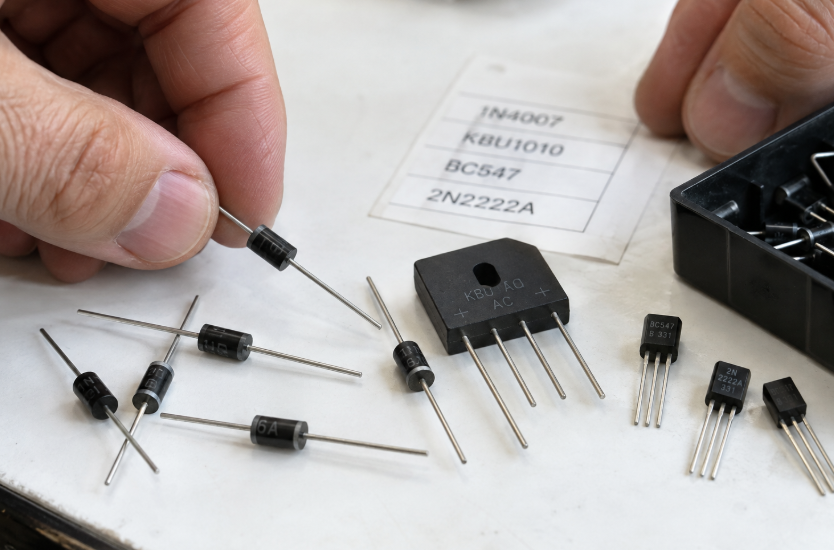
The full manufacturer part number, including its suffix, often determines the package, temperature range, qualification grade, lead finish, tolerance, packing method, or other purchasing details. Two parts with similar base numbers are not necessarily interchangeable.
Missing manufacturer part numbers and technical specifications
Each BOM line should contain enough information for a supplier to identify one orderable component. At minimum, buyers should provide the following fields when applicable:
| BOM field | Why it matters |
|---|---|
| Manufacturer | Prevents confusion between similar products from different brands |
| Full manufacturer part number | Identifies the exact orderable configuration |
| Description | Provides a secondary check against data-entry errors |
| Package or case | Helps detect incompatible package variants |
| Required quantity | Supports stock, reel, tray, and price-break verification |
| Temperature or qualification grade | Separates commercial, industrial, automotive, and other versions |
| Approved alternatives | Shows which substitutions have already received engineering approval |
| Target delivery date | Allows the supplier to evaluate schedule feasibility |
| Date-code or lot requirement | Prevents a restriction from appearing only after material is sourced |
| Documentation requirement | Defines whether declarations, lot photos, test reports, or other records are needed |
The description should support the part number, not replace it. A mismatch between the description and manufacturer part number should stop the quotation until the buyer confirms which field is correct.
Confusing similar part numbers, packages, or component grades
Small suffix differences can affect tape-and-reel packaging, pin count, mounting style, voltage rating, tolerance, operating temperature, or qualification status. A part may have the correct electrical function but still be unusable on the specified PCB footprint.
Procurement should compare the full part number against the current datasheet and product page. When a suffix remains unclear, request the package drawing or ordering-information table and ask engineering to confirm the selection.
Never silently shorten a part number to make sourcing easier. If the exact component is unavailable, list any proposed alternative separately and identify every difference requiring technical review.

Why BOM errors create requoting and procurement delays
An incomplete BOM triggers a predictable chain of delays. The supplier asks for clarification, the buyer returns to engineering, the quotation is revised, and stock may change before the line is approved.
A wrong part number can create a more serious problem. The material may arrive before anyone notices an incompatible package, temperature grade, or specification. The business then faces inspection failure, return negotiations, new sourcing work, and an idle production schedule.
A short BOM review before releasing the RFQ is usually faster than correcting these issues after a purchase order has been placed.
Starting component sourcing too late
PCB fabrication, enclosure production, firmware development, and final assembly do not always follow the same schedule. Component sourcing should begin while the production plan is still flexible, not after every other date has been fixed.
The goal is not necessarily to buy every component immediately. It is to identify which BOM lines could control the entire schedule.
Why lead time should be checked before production is scheduled
Supplier lead time is only one part of the timeline. Buyers should also account for quotation approval, payment, supplier processing, inspection, international transport, customs clearance, receiving inspection, and any customer-specific testing.
A quoted lead time should be tied to the exact quantity and stock location. “Available” may mean the material is physically on hand, held by another supplier, expected from a manufacturer, or merely listed in a database. Ask for a clear stock statement before scheduling production around it.
Identifying long-lead-time and allocation-risk components early
MCUs, processors, FPGAs, power semiconductors, specialized connectors, sensors, and relays can become schedule bottlenecks. Risk also increases when a component is sole-source, obsolete, subject to allocation, customized, or available only in quantities that do not match the build.
Classify BOM lines before final production scheduling:
- Critical: no approved alternative, long lead time, limited supply, or high application impact.
- Controlled: available from several reviewed sources but still requires lot, packaging, or compliance verification.
- Standard: broadly available and supported by approved equivalents or multiple qualified suppliers.
Check critical parts first. If they cannot meet the target date, engineering and production planning need time to consider a validated alternative, redesign, partial build, or revised schedule.
Choosing components based only on the lowest quote
The lowest unit price does not always produce the lowest procurement cost. A quotation has limited value if it does not clearly identify the manufacturer, full part number, quantity, source, stock status, lead time, lot condition, date code, packaging, documentation, and return terms.
An unusually low quote deserves clarification. It may involve mixed lots, older material, repackaged components, uncertain availability, incomplete traceability, incorrect grades, or stock that has not been verified. A low quotation is not itself evidence of a quality problem, but unexplained differences should not be ignored.
Compare quotations on the same basis:
| Factor | Question to ask |
|---|---|
| Part identity | Does the quote show the complete manufacturer part number? |
| Stock status | Is the material physically available and in what location? |
| Lot condition | Is it a single lot or a mixture of date and lot codes? |
| Packaging | Is it supplied in original, manufacturer-labeled, or disclosed repackaged packaging? |
| Traceability | Which source and chain-of-custody records can be provided? |
| Inspection | What checks will be performed, and what evidence will be shared? |
| Delivery | Does the lead time include inspection and dispatch preparation? |
| After-sales terms | What happens if the delivered material fails the agreed acceptance criteria? |
A purchasing team should define acceptance requirements before choosing a supplier. Otherwise, two quotations that appear to cover the same component may represent very different materials and risk levels.
Inspection failure, replacement freight, engineering time, rework, and production downtime can quickly exceed the saving from a cheaper quotation.

Ignoring component lifecycle and obsolescence status
A component may still appear on supplier websites after its manufacturer has limited new designs, announced a last-time buy, or discontinued production. That matters for repeat orders even when enough stock is available for the first build.
Lifecycle status should be reviewed during design and again before a significant purchase. Use the manufacturer’s current product page, product change notifications, and discontinuance notices rather than relying on an unverified database label.
Active, NRND, Last-Time-Buy, and Obsolete components
Status terminology differs among manufacturers, but buyers commonly encounter:
- Active: the manufacturer currently lists the component for production or sale.
- NRND: not recommended for new designs. Existing production may continue, but long-term availability needs review.
- Last-Time-Buy: the manufacturer has announced a final ordering window before discontinuation.
- Obsolete or discontinued: regular manufacturer production has ended.
The label alone is not enough. Record the source, date checked, announcement number, last-order date, last-shipment date, and affected part numbers.
How obsolete parts can disrupt repeat production
Obsolete parts are common in industrial equipment, repair projects, legacy controls, medical systems, and products with long service lives. The first production run may succeed using remaining stock, but the next order could depend on a smaller and less traceable supply pool.
Before committing to a legacy component, estimate demand across production, maintenance, warranty support, and expected repeat orders. Confirm whether the available quantity belongs to one lot or several and whether storage and packaging evidence is suitable for the application.
For more context on evaluating codes and older material, see How to Verify the Date Code of Electronic Components.
When to evaluate approved alternatives
Alternative evaluation should begin when lifecycle or supply risk first becomes visible. Waiting until stock is exhausted puts engineering under unnecessary schedule pressure.
Purchasing can identify candidate parts, but engineering must approve technical equivalence. Review electrical limits, pinout, footprint, timing, thermal behavior, firmware impact, package, qualification, regulatory status, and lifecycle. Form, fit, and function claims should be supported by current manufacturer documentation and appropriate validation.
An alternate should not replace the original BOM line without a controlled revision and approval record.
Relying on a single supplier without a backup plan
A single supply channel concentrates risk. Stock can be sold, a shipment can be delayed, documentation can prove insufficient, or a supplier can fail to meet an agreed inspection requirement.
The solution is not to buy from unreviewed sellers whenever a shortage occurs. A backup supplier should pass the same qualification process as the primary supplier.
For critical components, a basic continuity plan may include:
- A primary supplier for routine purchasing.
- One or more reviewed backup sources.
- An approved-alternative list maintained by engineering.
- Safety stock based on consumption, replenishment time, lifecycle risk, and storage requirements.
- Defined escalation rules when stock or lead time changes.
Safety stock requires judgment. Excess material can create cash-flow, storage, oxidation, moisture-control, or obsolescence problems. The appropriate quantity depends on demand variability, replenishment risk, shelf and packaging conditions, and the consequences of a shortage.
Do not split an order across several suppliers merely to create the appearance of diversification. Multiple sources may introduce mixed lots, inconsistent documentation, or greater inspection complexity. Use each source only after the material and supplier have been reviewed.
Failing to verify supplier traceability and component quality
Supplier verification should take place before payment, not only after material arrives. Once the transaction is complete, the buyer has less time and leverage to resolve unclear stock, packaging, or documentation.
DuoLink operates as an independent electronic-component supplier, so each inquiry should be assessed according to the offered supply route and the customer’s risk requirements. Independent sourcing can help with shortages, obsolete parts, and difficult BOM lines, but it requires clear evidence and risk-based inspection.
Checking source, lot code, date code, and supporting records
Ask the supplier to confirm:
- Whether the material is on hand, supplier-held, consigned, or expected.
- The complete manufacturer part number and offered quantity.
- Available date-code and lot-code information.
- Whether the order contains one lot or mixed lots.
- The packaging type and condition.
- The available traceability or chain-of-custody records.
- Whether current photos can be supplied before shipment.
- Which inspection and return terms apply.
Compare component markings with reel, tube, tray, bag, and carton labels. Look for unexplained conflicts in the part number, suffix, quantity, lot, date code, packaging, or country information.
Consistency supports the review but does not by itself prove authenticity. Legitimate material can be repacked, manufacturers can change labels or marking equipment, and different production sites can create visible variation. Record the discrepancy and seek supporting evidence before reaching a conclusion.
Using inspection and testing for higher-risk components
The inspection plan should match the component value, supply channel, application, and consequence of failure.
A lower-risk purchase may require document review, label comparison, packaging inspection, and visual examination. Higher-risk or uncertain material may justify dimensional checks, marking inspection under magnification, X-ray, XRF, solderability testing, electrical testing, decapsulation, or functional testing.
Not every test applies to every component. Some methods are destructive, some only screen for particular anomalies, and electrical testing requires valid limits and appropriate equipment. The buyer and supplier should agree on the sample quantity, acceptance criteria, laboratory, chain of custody, and responsibility for destructive samples before testing begins.
Visible sanding, resurfacing, blacktopping, inconsistent markings, oxidation, solder residue, or damaged packaging are warning signs. They are not standalone proof that a component is counterfeit. Suspicious material should be quarantined while evidence is reviewed.
Why supplier verification should happen before payment
Before approving payment, obtain a quotation that clearly identifies the material and commercial terms. Request current stock photos or supporting records when the risk warrants them. Check that the supplier’s legal entity, payment account, contact information, and invoice details are consistent.
Document the agreed date-code limits, lot restrictions, packaging, inspection, compliance records, and delivery terms in the purchase order or quality agreement. Requirements mentioned only in informal messages are easier to misunderstand.
DuoLink buyers can submit a complete BOM or individual part inquiry through the Request a Quote page and state the required manufacturer, quantity, target delivery date, application, date-code preference, documentation, and inspection needs.
Managing the BOM as a one-time purchase list
A BOM continues to change after the first RFQ. Engineering revisions, supplier changes, stock movement, price changes, production quantities, approved alternatives, and delivery dates can all affect the sourcing plan.
Treat the BOM as a controlled project record rather than a spreadsheet copied between inboxes.
Tracking stock, lead-time, and price changes throughout the project
Every quotation has a date and validity period. Stock shown during the first inquiry may no longer be available when the purchase order is released. Lead times can also change between prototype and mass production.
Record the quotation date, source, offered quantity, stock location, lead time, lifecycle status, lot information, inspection requirement, and approval status for each critical line. Reconfirm high-risk components before issuing the order.
When the build quantity changes, do not simply multiply the prototype order. Mass production may require full reels, different packaging, longer replenishment time, broader lot control, or additional qualification.
Keeping engineering, procurement, and suppliers aligned
Engineering owns technical suitability and design approval. Procurement owns sourcing, commercial review, and supplier coordination. Quality defines receiving and inspection requirements. Production planning connects material availability to the build schedule.
All teams should work from the same BOM revision. If engineering approves an alternative, the record should identify who approved it, when it was approved, which applications it covers, and whether validation is complete.
Suppliers should receive only the current released version. A revision number, issue date, change log, and responsible owner reduce the risk of quoting or shipping against an outdated file.
Building a BOM sourcing checklist for future production runs
Before releasing each sourcing cycle, confirm:
- The BOM revision matches the current design.
- Every critical line has a complete manufacturer part number.
- Package, grade, quantity, and delivery requirements are defined.
- Lifecycle and PCN or PDN status have been checked.
- Long-lead-time and sole-source components have been flagged.
- Approved alternatives are recorded separately from proposed alternatives.
- Primary and backup suppliers have been reviewed.
- Traceability, packaging, lot, date-code, and compliance needs are documented.
- Inspection and testing requirements are agreed before payment.
- Stock and lead time are reconfirmed before the purchase order is issued.
Save the final purchase records with the BOM. The next production run should begin with verified history rather than reconstructing decisions from old emails.

Conclusion
These seven BOM sourcing mistakes share one cause: purchasing begins before the technical, schedule, supplier, and acceptance requirements are clear.
A controlled process starts with a complete BOM, identifies critical components early, checks lifecycle and supply risk, compares quotations on more than price, verifies suppliers before payment, and keeps the sourcing record current throughout the project.
DuoLink Electronics is an independent supplier supporting BOM sourcing, part-number lookup, inventory inquiries, and hard-to-find electronic components. Buyers can provide the full manufacturer part number, required quantity, target delivery date, application, date-code or lot preferences, and documentation requirements for a more precise sourcing review. Availability, traceability, inspection scope, and component suitability should be confirmed for each order.
Frequently Asked Questions
What information should I include when requesting a BOM quotation?
Include the manufacturer, complete manufacturer part number, description, package, required quantity, target delivery date, approved alternatives, application, and any date-code, lot, packaging, inspection, or documentation requirements.
Which BOM components should be sourced first?
Start with parts that have long lead times, one approved manufacturer, limited stock, lifecycle risk, unusual packaging, or a high effect on product function. MCUs, FPGAs, power devices, specialized connectors, sensors, and relays often require early review, but the actual priority depends on the design.
Does a low component price indicate counterfeit material?
No. Price alone cannot establish authenticity. An unusually low quotation should prompt questions about stock status, source, lot condition, packaging, traceability, inspection, and return terms.
Can purchasing approve an alternative component?
Purchasing can locate candidates and collect supporting documentation, but engineering should approve technical suitability. Pinout, footprint, electrical limits, timing, thermal behavior, firmware, qualification, compliance, and lifecycle differences may require review or validation.
Is visual inspection enough to verify electronic components?
Visual inspection can identify inconsistencies and physical warning signs, but it does not conclusively prove authenticity. Higher-risk material may require document review, expanded sampling, X-ray, XRF, electrical testing, solderability testing, decapsulation, or application-specific functional testing.
How often should a BOM sourcing plan be updated?
Update it whenever the design, quantity, approved alternatives, stock status, lead time, supplier, lifecycle status, inspection requirement, or production schedule changes. Critical lines should be reconfirmed before each production order.


 English
  German
  Spanish
  French
  Chinese
  Italian