
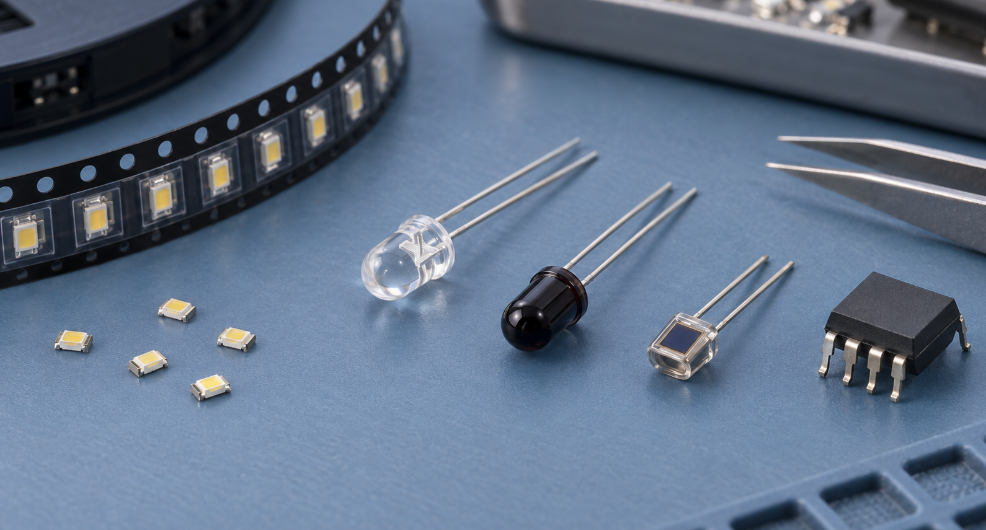
Optoelectronic components create, detect, control, or convert light. Some produce visible or infrared light, while others receive optical signals and convert them into electrical outputs. They are used in communication systems, industrial automation, medical equipment, vehicles, consumer electronics, displays, and safety systems.
The word “optoelectronic” covers a broad range of components. Two devices may look similar while having very different output structures, response speeds, wavelengths, or circuit requirements. Buyers should therefore select them by function and datasheet parameters, not by appearance or category name alone.
This guide explains ten common optoelectronic components and the specifications that purchasing managers and engineers should check before approving a part.
1. Light-emitting diodes (LEDs)
What LEDs do in electronic circuits
A light-emitting diode converts electrical energy into light when current flows through its semiconductor junction in the forward direction. The emitted wavelength depends mainly on the semiconductor material and device construction.
LEDs are not limited to general lighting. Small indicator LEDs show power, operating status, alarms, and communication activity. Higher-output devices are used in automotive lighting, industrial equipment, optical sensing, infrared illumination, and machine vision.
The Duolink optoelectronics category includes 0603 indicator LEDs and infrared emitters for different applications.
Common LED types
Indicator LEDs are typically selected for status lights, control panels, and compact electronic assemblies. High-power LEDs provide greater optical output but may need closer attention to thermal management.
Infrared LEDs emit light outside the visible spectrum. They are used in remote controls, light barriers, machine vision, proximity detection, and optical communication. UV LEDs serve curing, sensing, sterilization, inspection, and fluorescence applications, although suitability depends on wavelength and output power.
Specifications to check when selecting LEDs
The color name alone is not enough to identify an LED. Buyers should confirm:
- Peak or dominant wavelength
- Forward voltage
- Recommended forward current
- Luminous intensity or radiant intensity
- Viewing angle
- Package dimensions and mounting type
- Operating temperature range
- Polarity and pin configuration
- Moisture sensitivity and reflow conditions for SMD parts
For visible LEDs, luminous intensity describes output as perceived by the human eye. Infrared emitters are more commonly evaluated through radiant intensity or radiant power. These values should not be treated as interchangeable.
2. Laser diodes
A laser diode produces a narrow, concentrated beam of coherent light. Compared with an ordinary LED, its optical output is more directional and has a narrower spectral range.
Laser diodes are used in fiber-optic communication, barcode scanners, LiDAR, optical storage, medical instruments, alignment systems, and industrial measurement equipment. The application determines whether the design needs continuous-wave output, pulsed operation, a specific beam profile, or feedback from a monitor photodiode.
Wavelength is only the first selection factor. The engineer should also review optical output power, threshold current, operating current, forward voltage, package, monitor-photodiode configuration, operating temperature, and thermal requirements.
Laser diodes are sensitive to electrostatic discharge, overcurrent, and temperature. Purchasing teams should confirm the complete part number and package configuration rather than accepting a device based only on wavelength and nominal power. Any replacement also requires engineering approval because the optical characteristics and drive conditions may differ.
3. Photodiodes
How photodiodes convert light into electrical signals
A photodiode is a semiconductor detector that generates a current when light reaches its active junction. The amount of current generally corresponds to the incident optical power within the device’s specified spectral range.
Photodiodes are used in optical communication, light measurement, medical instruments, safety equipment, encoders, infrared detection, and industrial sensing. They are often paired with an amplifier because the generated current may be too small for direct processing.
The surrounding circuit matters. Bias condition, amplifier bandwidth, input capacitance, noise, and PCB layout can all affect the performance of the detector.
PIN photodiodes vs. avalanche photodiodes
A PIN photodiode has a wide intrinsic region between its semiconductor layers. It is widely used where low capacitance, good linearity, and fast response are needed.
An avalanche photodiode, or APD, provides internal gain when operated at a higher reverse-bias voltage. It can detect weaker optical signals, but it needs a more demanding bias and control circuit. Noise, temperature behavior, and breakdown voltage must be considered.
An APD should not be treated as a higher-sensitivity drop-in replacement for a PIN photodiode.
Responsivity, dark current, and response time
Responsivity indicates how much electrical output a photodiode produces for a given optical input at a specified wavelength. Dark current is the small current that exists without illumination and can affect low-light measurements. Response time or bandwidth determines how quickly the device can follow a changing optical signal.
Photodiodes, phototransistors, and photoresistors are not equivalent:
| Component | Typical strength | Typical limitation | Common use |
|---|---|---|---|
| Photodiode | Fast and suitable for precise measurement | Often needs amplification | Communication and instrumentation |
| Phototransistor | Higher inherent sensitivity | Usually slower than a photodiode | Detection and switching |
| Photoresistor | Simple resistance-based interface | Slow response and broad tolerance | Basic light control |
A replacement should account for the circuit topology as well as the optical specifications.
4. Phototransistors
A phototransistor uses incident light to control collector current. Its transistor action provides more signal gain than a basic photodiode, which makes it useful when sensitivity matters more than very high speed or linear measurement.
Typical applications include object detection, counters, position sensing, optical switches, security systems, and industrial automation. Phototransistors are also frequently used as the detector inside photointerrupters and basic optocouplers.
Compared with a photodiode, a phototransistor normally provides a larger electrical output but responds more slowly. Saturation can further extend its turn-off time. This matters in encoders, pulse counters, and communication circuits.
Before purchasing, check spectral sensitivity, collector-emitter voltage, collector current, dark current, rise and fall times, viewing angle, package, and operating temperature. The test conditions shown in the datasheet are important because sensitivity and switching-time figures cannot be compared fairly when manufacturers use different currents, loads, or illumination levels.
5. Optocouplers and optoisolators
How an optocoupler provides electrical isolation
An optocoupler contains an input light source, usually an LED, and an output photodetector inside one package. The optical path transfers a signal while maintaining electrical separation between the input and output circuits.
These devices are found in power supplies, motor drives, industrial controls, communication interfaces, feedback circuits, and systems that need signal transfer across different electrical domains.
Isolation performance depends on more than the voltage printed in a product title. Engineers may need to evaluate working voltage, transient voltage, creepage distance, clearance, insulation construction, common-mode transient immunity, and the applicable safety approval.
Phototransistor vs. high-speed logic optocouplers
A PC817-type device normally uses a phototransistor output. It is suitable for slower switching, feedback, and general isolation tasks where current transfer ratio is important.
A 6N137-type optocoupler uses an integrated high-speed detector and logic output. Vishay describes its 6N137 family as a single-channel 10 MBd optocoupler with an open-drain output. It is intended for applications such as digital bus isolation and microprocessor interfaces. The manufacturer’s 6N137 product information also shows why output structure and logic requirements must be checked.
A PC817 and a 6N137 should not be interchanged simply because both are optocouplers. Their pin counts, supply requirements, speed, output stages, and application conditions differ.
CTR, isolation voltage, and switching speed
For a phototransistor optocoupler, current transfer ratio, or CTR, describes the relationship between output collector current and input LED current under stated test conditions. CTR can vary by grade, temperature, LED current, and device aging.
High-speed logic optocouplers are more commonly selected by data rate, propagation delay, pulse-width distortion, threshold behavior, output type, and common-mode transient immunity.
The purchasing checklist should include:
- Full manufacturer part number and CTR bin
- Input forward-current conditions
- Output type and supply requirements
- Data rate or switching-time requirement
- Isolation rating and applicable approval
- Creepage and clearance requirements
- Package and pin configuration
- Temperature grade
- Tape, reel, tube, or tray requirement
Duolink lists PC817, LTV-817, 6N137, TLP291-4, and VO615A series parts in its optoelectronics range. Availability and exact suffixes should be confirmed for each inquiry.
6. Infrared emitters and receivers
Infrared emitters generate light that is generally invisible to the human eye. Receivers detect the infrared signal and convert it into an electrical output.
They are used in remote controls, automatic doors, object counters, proximity sensors, light barriers, industrial detection, and optical communication. Some receivers are simple photodiodes or phototransistors. Others contain filters, amplifiers, and demodulation circuits.
Emitter and receiver wavelength matching is one of the first design checks. An 850 nm emitter and a receiver optimized for another spectral region may still show some response, but the system may lose detection range or noise margin. A matching package does not prove spectral compatibility.
Buyers should compare the emitter’s peak wavelength with the receiver’s spectral sensitivity curve. They should also check radiant intensity, optical angle, drive current, detector sensitivity, response time, ambient-light rejection, package orientation, and operating temperature.
Duolink’s SFH 4253 infrared LED page provides an example of an 860 nm surface-mount emitter. The complete design still needs a compatible receiver and suitable drive circuit.

7. Ambient light and proximity sensors
Ambient light sensors measure surrounding illumination so that a controller can adjust display brightness, lighting, power consumption, or equipment behavior. Integrated sensors may contain a photodetector, signal-conditioning circuitry, an analog-to-digital converter, and a digital interface.
Applications include smartphones, tablets, automotive displays, smart lighting, appliances, consumer electronics, and industrial control equipment.
Proximity sensors often combine an infrared emitter and detector. The sensor measures reflected light to determine whether an object is present. Housing design, cover-glass transmission, target color, distance, alignment, and ambient infrared energy can influence the result.
Important selection parameters include spectral response, measurement range, resolution, supply voltage, interface, conversion time, package, interrupt functions, and operating temperature. For digital devices, the register map and software compatibility also matter.
The VEML7700, for example, is an integrated ambient light sensor with an I²C interface. Vishay’s official VEML7700 product page should be checked for current datasheets and design information before approving a specific suffix.
8. Photoresistors and light-dependent resistors
A photoresistor, also called a light-dependent resistor or LDR, changes resistance as incident light changes. Its straightforward interface makes it useful in simple light-detection circuits.
Common applications include automatic lamps, light meters, alarm systems, display-brightness controls, toys, and basic daylight detection. A voltage-divider circuit may be enough when the application only needs to distinguish between general light and dark conditions.
LDRs are usually slower than photodiodes and may have broad part-to-part tolerances. Their resistance, recovery behavior, spectral response, temperature effects, and environmental compliance should be checked.
A photodiode is not automatically better than an LDR. The correct choice depends on the measurement:
- Use an LDR when the circuit needs simple, low-speed light detection.
- Use a photodiode when speed, repeatability, bandwidth, or calibrated optical measurement matters.
- Use an integrated ambient light sensor when the system needs a digital value, controlled spectral response, or easier processor integration.
A substitution between these types normally requires a circuit change.
9. Photointerrupters and reflective optical sensors
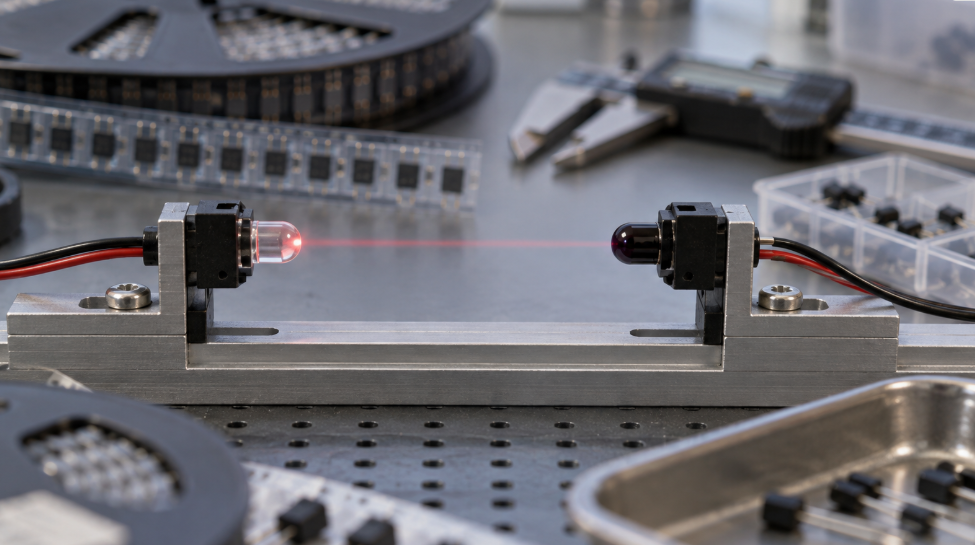
A photointerrupter usually combines an infrared emitter and a phototransistor or photodiode in one package. This fixed geometry reduces alignment work and makes the component useful in compact mechanical systems.
A slotted photointerrupter places the emitter and detector on opposite sides of a slot. A moving flag, paper edge, gear, or encoder wheel interrupts the beam. Applications include printer paper detection, motor-position sensing, rotary mechanisms, object counting, and limit detection.
A reflective optical sensor places the emitter and detector on the same side. It detects light reflected by a nearby target. Performance can change with target distance, surface color, texture, angle, and ambient light.
For either type, check slot width or sensing distance, mechanical dimensions, wavelength, detector output, current ratings, switching time, mounting method, and operating temperature. The PCB footprint alone does not confirm mechanical compatibility.
The OPB817Z slotted optical switch is an example of a phototransistor-output device used for interruption-based sensing.
10. Optoelectronic displays
Optoelectronic displays convert electrical signals into visible information. This group includes individual LED displays, seven-segment displays, dot-matrix displays, and display modules.
They are used in industrial control panels, measurement instruments, appliances, consumer products, automotive dashboards, and medical equipment. A seven-segment display may show a simple numeric value, while a dot-matrix device can present characters or basic graphics.
Purchasing teams should not identify a display only by its dimensions and color. The following details can determine compatibility:
- Common-anode or common-cathode configuration
- Number and arrangement of segments
- Forward voltage and segment current
- Color and dominant wavelength
- Luminous intensity
- Multiplexing requirements
- Pin layout
- Viewing angle
- Character height and mechanical dimensions
- Operating temperature
- Driver compatibility
Displays that look identical from the front may have different pinouts or internal connections. Requesting a drawing and current datasheet before approving an alternate can prevent PCB and firmware problems.
Quick comparison of optoelectronic components
| Component | Main function | Important selection parameters |
|---|---|---|
| LED | Produces visible or infrared light | Wavelength, current, intensity, angle |
| Laser diode | Produces concentrated coherent light | Wavelength, optical power, threshold current |
| Photodiode | Detects light at high speed | Responsivity, dark current, bandwidth |
| Phototransistor | Detects light with internal gain | Sensitivity, switching time, dark current |
| Optocoupler | Transfers a signal across isolation | CTR or data rate, isolation, output type |
| IR emitter and receiver | Sends and detects infrared signals | Spectral matching, intensity, sensitivity |
| Ambient light sensor | Measures surrounding light | Range, resolution, interface, spectral response |
| Photoresistor | Changes resistance with light | Light/dark resistance, response time |
| Photointerrupter | Detects motion or obstruction | Slot, sensing distance, output, speed |
| Display | Presents visible information | Configuration, pinout, intensity, dimensions |
Conclusion
The optoelectronic category includes both light emitters and detectors, as well as integrated devices that use light to isolate, sense, communicate, or display information. Selecting the correct type is only the beginning. The full manufacturer part number, optical characteristics, electrical ratings, package, temperature range, and application requirements must also match.
When sourcing an optoelectronic component, provide the manufacturer, complete part number, required quantity, package, target application, operating temperature, and any wavelength, speed, isolation, or documentation requirements.
Duolink Electronics is an independent electronic-component supplier supporting part-number inquiries, BOM sourcing, availability checks, and hard-to-find component requirements. Buyers can contact Duolink Electronics with their technical and purchasing details for review.
Frequently asked questions
What is an optoelectronic component?
An optoelectronic component produces, detects, controls, or converts light. Common examples include LEDs, photodiodes, phototransistors, optocouplers, optical sensors, photointerrupters, and displays.
Can a phototransistor replace a photodiode?
Usually not without circuit review. A phototransistor offers internal current gain but is generally slower and less linear. A photodiode may need a separate amplifier but is better suited to fast or precise optical detection.
Can PC817 and 6N137 optocouplers be interchanged?
No. A PC817-type device normally has a phototransistor output, while a 6N137-type device uses a high-speed logic detector. Their pinouts, supply requirements, switching speeds, and output circuits differ.
Why must an infrared emitter match the receiver wavelength?
A receiver’s sensitivity changes across the optical spectrum. Matching the emitter’s peak wavelength with the receiver’s spectral response improves signal strength, detection range, and noise margin.
What information should be included in an optoelectronic component RFQ?
Include the complete manufacturer part number, manufacturer, quantity, package, required wavelength or color, temperature grade, optical and electrical requirements, target application, packaging preference, and documentation needs.
Can two optoelectronic components with the same package be substitutes?
The same package does not confirm functional compatibility. Compare the pinout, wavelength, electrical ratings, optical output or sensitivity, response time, interface, temperature range, and qualification status. Engineering approval should be obtained before using an alternate.


 English
  German
  Spanish
  French
  Chinese
  Italian