
A diode is one of the smallest components on a circuit board, yet a wrong diode can stop an entire power supply, damage a protection circuit, increase heat, or create a failure that only appears after the product has been running for some time.
At a basic level, a diode controls the direction of electrical current. That explanation is correct, but it is not enough when you are designing a circuit or purchasing components for production. You also need to understand forward voltage, reverse voltage, leakage current, switching speed, surge capability, junction temperature, package type, and the way these values change under real operating conditions.
From years of reviewing component requirements and BOM lists, I have found that diode sourcing problems rarely start with the word “diode.” They usually start with a small detail: the right voltage but the wrong package, enough average current but not enough surge capability, or a substitute that looks close on paper but behaves differently at high temperature.
This guide explains what a diode is, how a diode works, the main types of diodes, their functions and applications, and the specifications you should check before selecting or sourcing one.
1. What Is a Diode?
Basic Definition of a Diode
A diode is a two-terminal semiconductor device designed to conduct current much more easily in one direction than in the opposite direction.
Most common semiconductor diodes are based on a PN junction formed by joining P-type and N-type semiconductor regions. Silicon is widely used, while other materials and device structures are selected when an application needs lower voltage loss, faster switching, light emission, optical sensing, high-frequency operation, or other specialized behavior.
Thinking of a diode as a “one-way electrical valve” is useful when learning the basic idea. Real components are more complicated.
A practical diode does not become a perfect conductor when it is turned on. It develops a forward voltage drop and generates heat. When reverse biased, it does not block current perfectly either. A small reverse leakage current can still flow. If the reverse voltage becomes high enough, the junction may enter breakdown.
That last point matters because breakdown is unwanted in an ordinary rectifier diode but is part of normal operation in devices such as Zener and TVS diodes.
JEDEC maintains standardized semiconductor terminology covering parameters such as forward current, reverse current, breakdown voltage, and other discrete-device characteristics. Using manufacturer datasheets together with standardized terminology helps engineers and buyers compare components more accurately.
Diode Symbol, Anode, and Cathode
A diode has two terminals:
| Terminal | Meaning | Typical Current Relationship |
|---|---|---|
| Anode | Forward-current entry side | Conventional current enters here during forward conduction |
| Cathode | Forward-current exit side | Conventional current leaves here during forward conduction |
In a standard diode schematic symbol, the vertical bar identifies the cathode side.
Physical components normally include a polarity mark as well. An axial rectifier diode often has a band at the cathode end. Surface-mount parts may use a line, notch, dot, package marking, or another manufacturer-defined indicator.
Never assume polarity from package shape alone.
For purchasing and incoming inspection, compare the manufacturer’s datasheet drawing with the actual package marking. This becomes even more important with dual diodes, common-anode devices, common-cathode devices, diode arrays, and packages where several electrical configurations use the same external body.
2. How Does a Diode Work?
PN Junction and Depletion Region
To understand how a diode works, start at the PN junction.
P-type semiconductor material contains holes as its majority carriers. N-type material contains electrons as its majority carriers. When the two materials meet, carriers near the junction diffuse across the boundary and recombine.
This process creates a region around the junction with very few mobile charge carriers. It is called the depletion region.
An internal electric field forms across this region. The field creates an energy barrier that resists further carrier movement.
This is why a diode does not simply act like a piece of wire.
Apply voltage in one direction and the barrier becomes easier for carriers to cross. Reverse the voltage and the depletion region grows, making current flow much more difficult.
The current-voltage relationship is not a perfect on/off step. Current changes continuously with applied voltage, temperature, semiconductor material, junction construction, and operating current.
Forward Bias vs. Reverse Bias
A diode is forward biased when the anode is at a higher electrical potential than the cathode by enough voltage for meaningful current to flow.
When this happens, the depletion barrier is reduced and conduction increases rapidly.
Under reverse bias, the cathode is at a higher potential than the anode. The depletion region widens and only a small leakage current normally flows until the diode approaches its breakdown region.
| Condition | Junction Behavior | Practical Result |
|---|---|---|
| Forward bias | Barrier is reduced | Diode conducts current |
| Reverse bias below rated limit | Barrier increases | Most current is blocked |
| Reverse breakdown | Reverse current rises sharply | May be intentional or damaging, depending on diode type |
This is the electrical behavior behind rectification, reverse-polarity protection, clamping, voltage reference circuits, signal steering, and many other diode applications.
Forward Voltage and Breakdown Voltage
Forward voltage, often shown as VF, is the voltage measured across the diode while it carries forward current.
A general-purpose silicon diode may show a forward drop somewhere around 0.6 to 0.8 V under common operating conditions, but you should never treat 0.7 V as a fixed rule.
VF changes with current and temperature.
A Schottky diode can have a much lower forward voltage in many operating ranges, which makes it attractive for low-voltage power conversion. The trade-off can include higher reverse leakage and different reverse-voltage capabilities.
LED forward voltage depends strongly on semiconductor chemistry, color, current, and temperature.
Breakdown voltage refers to the reverse-bias point at which reverse current increases sharply.
For an ordinary rectifier, your circuit should normally remain safely below its rated reverse voltage. A Zener diode is intentionally operated within a controlled breakdown region. A TVS diode uses avalanche behavior to clamp short transient voltages.
The word “breakdown” does not automatically mean the device has failed. You need to understand what the diode was designed to do.
3. What Are the Main Functions of a Diode?
Rectification and Current Control
Rectification is one of the best-known diode functions.
AC voltage changes polarity repeatedly. A diode can block one polarity and conduct the other. This behavior allows diode circuits to produce a unidirectional waveform that can then be filtered and regulated into DC.
A single diode can form a half-wave rectifier. Multiple diodes can form a full-wave or bridge rectifier.
For a bridge rectifier, current usually passes through two diodes during each conduction path. That means forward-voltage losses from both devices affect efficiency and heat generation.
A diode can also prevent current from flowing backward through a circuit. This is useful for supply isolation, battery protection, power-path control, relay coils, and circuits connected to more than one supply source.
The current-control function sounds simple. The selection is not.
You need to check continuous current, repetitive peak current, surge current, thermal conditions, voltage margin, and the actual waveform seen by the diode.
Voltage Regulation and Circuit Protection
Zener diodes can maintain a controlled voltage across a circuit when operated within their specified reverse-breakdown region. They are widely used for voltage references, simple regulation, and clamping.
TVS diodes serve a different purpose.
A TVS diode reacts to short voltage transients and diverts transient current away from sensitive circuitry. These devices may protect power inputs, communication lines, automotive electronics, industrial interfaces, and data ports from electrical overstress.
The key purchasing mistake here is treating every “protection diode” as interchangeable.
For a TVS diode, the working standoff voltage, breakdown voltage, clamping voltage, peak pulse power, pulse waveform, capacitance, and polarity all matter.
For high-speed data lines, capacitance may become just as important as surge capability. A protective device with too much junction capacitance can distort a high-speed signal even if its voltage rating looks acceptable.
Switching and Signal Processing
Small-signal and switching diodes are designed for fast electrical transitions.
They appear in waveform clipping, clamping, logic steering, detection, modulation, demodulation, and signal-routing circuits.
Reverse recovery deserves close attention here.
After a conventional PN diode has been conducting in the forward direction, stored charge does not disappear instantly when polarity reverses. A brief reverse current can flow while this charge is removed. The duration is associated with reverse recovery time, commonly written as trr.
At 50 or 60 Hz, a relatively slow diode may work perfectly well in a simple rectifier.
Move that same device into a high-frequency switching power supply and switching loss, heat, and electromagnetic noise can become a problem.
That is why “same voltage and same current” does not automatically mean “same diode.”
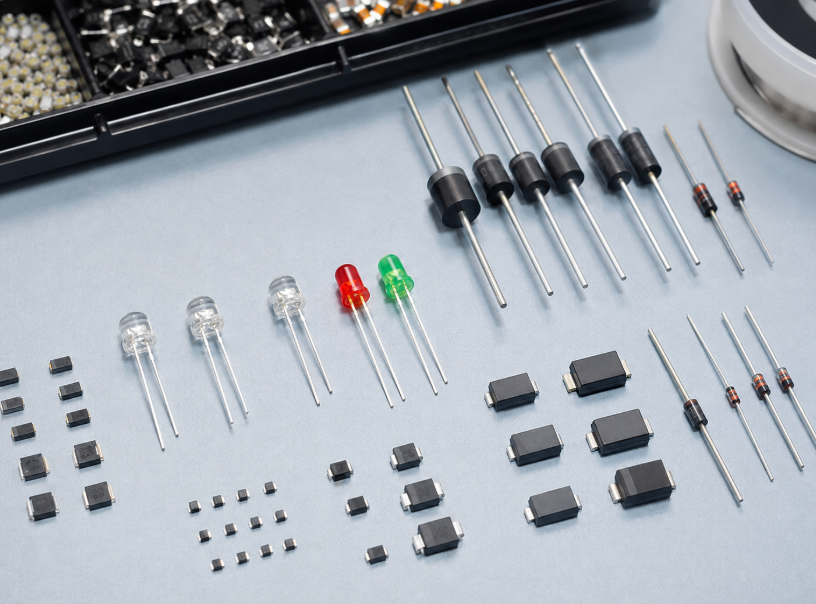
4. Common Types of Diodes
Rectifier Diodes
Rectifier diodes are built primarily to handle power conversion and directional current.
They are common in adapters, power supplies, chargers, motor-control equipment, appliances, industrial electronics, and power-input stages.
Selection normally centers on repetitive reverse voltage, average forward current, surge current, forward voltage, thermal behavior, and switching speed.
A traditional rectifier used on low-frequency mains power may prioritize voltage and surge capability. An ultrafast rectifier used in a switching converter needs much closer attention to reverse recovery.
If you are comparing actual component options, you can also review the Diodes & Rectifiers category, which includes standard rectifiers, fast-switching diodes, bridge rectifiers, Schottky devices, and protection diodes. The available category reflects the range of diode functions that may appear within one BOM rather than treating every diode as the same class.
Zener, Schottky, and TVS Diodes
These three diode families are often grouped together in component lists, but their jobs are quite different.
| Diode Type | Main Strength | Common Selection Concern |
|---|---|---|
| Zener diode | Controlled reverse breakdown | Zener voltage, tolerance, test current, power |
| Schottky diode | Low forward voltage and fast switching | Reverse voltage, leakage, temperature |
| TVS diode | Transient voltage suppression | Standoff voltage, clamp voltage, surge rating, capacitance |
Zener diodes are commonly used for voltage reference and voltage limiting. Look at the test current used to specify the Zener voltage. The device may not produce exactly the nominal voltage when operated far away from that current.
Schottky diodes use a metal-semiconductor junction rather than the conventional PN junction used in many other diodes. Their low forward drop can improve efficiency in low-voltage circuits. Reverse leakage can rise significantly with temperature, so room-temperature comparisons alone may hide an important design issue.
TVS diodes are designed to absorb or redirect short transient energy. Check the actual clamping behavior at the specified pulse current instead of choosing only by the voltage printed in the part description.
LEDs, Photodiodes, PIN Diodes, and Other Specialized Diodes
A diode does not have to be used only for power.
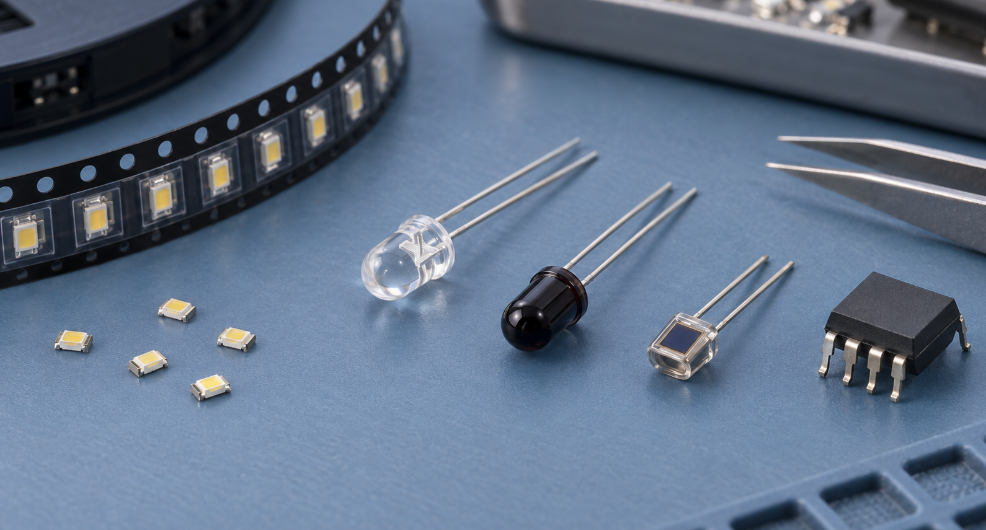
An LED converts electrical energy into light. Its forward current, wavelength or color, luminous characteristics, viewing angle, thermal conditions, and package need to match the application.
A photodiode performs the opposite type of conversion. Incoming light generates an electrical response, making photodiodes useful in optical sensors, receivers, measurement systems, medical equipment, and communication devices.
A PIN diode contains an intrinsic semiconductor region between the P and N regions. This structure gives it useful behavior in RF switching, attenuation, microwave circuits, and some photodetection applications.
Other specialized devices include avalanche diodes, varactor diodes, laser diodes, step-recovery diodes, ESD protection arrays, and RF detector diodes.
The core diode principle remains familiar. Device construction changes to optimize one electrical or optical behavior.
5. Key Diode Specifications and Ratings
Forward Voltage and Forward Current
When reviewing a diode datasheet, start by asking what current will actually pass through the component.
IF usually refers to forward current, but the datasheet may distinguish average forward current, continuous current, repetitive peak current, and non-repetitive surge current.
These values are not interchangeable.
A diode rated for 1 A average current may be able to tolerate a much larger short surge. That does not mean it can continuously carry the surge rating.
Forward voltage also needs to be checked at the relevant current.
For power circuits, you can make a first thermal estimate using:
Power loss ≈ Forward voltage × Forward current
That is only a starting point because the waveform, duty cycle, switching behavior, temperature, and thermal resistance also affect actual device heating.
Reverse Voltage and Leakage Current
Reverse-voltage specifications may appear under names such as VR, VRRM, VRWM, or related manufacturer-specific conditions.
Do not simply choose a diode whose nominal voltage rating barely exceeds the supply voltage.
A real circuit can experience switching spikes, transformer leakage effects, inductive transients, supply variation, load dump events, or other conditions that increase the voltage across the diode.
Reverse leakage, normally represented by IR, also deserves more attention than it gets.
In many silicon rectifiers it is small enough that designers rarely think about it. In high-temperature circuits, battery-powered equipment, high-impedance sensing, or some Schottky applications, leakage can become meaningful.
Always read the conditions beside the specification. A leakage-current value measured at 25°C tells you little about worst-case performance if your product operates at 100°C or more.
Recovery Time, Power Dissipation, and Package Type
Reverse recovery time is a major parameter in switching circuits.
A slower recovery diode can increase switching loss and noise. Fast and ultrafast rectifiers are designed to reduce this effect. Schottky diodes do not exhibit the same minority-carrier reverse-recovery behavior as conventional PN rectifiers, although parasitic capacitance and switching behavior still exist.
Power dissipation tells only part of the thermal story.
Check maximum junction temperature, thermal resistance, PCB copper area requirements, case temperature conditions, and derating curves.
Package type matters electrically and mechanically.
A DO-41 axial diode, SOD-123 surface-mount diode, SMA rectifier, SMB TVS device, or TO-220 dual rectifier may perform very different roles even if several headline electrical values appear similar.
For BOM purchasing, I normally recommend checking at least these fields before approving a diode substitution:
manufacturer part number, diode type, polarity/configuration, reverse-voltage rating, forward-current rating, surge rating, forward voltage, leakage current, recovery time where relevant, package, pinout, junction temperature, and compliance requirements.
Package and terminology references published through JEDEC semiconductor standards can also help procurement and engineering teams work from consistent device definitions rather than informal naming alone.
6. Common Applications of Diodes
Power Supplies and AC-to-DC Rectification
Power conversion remains one of the largest diode application areas.
Diodes appear in bridge rectifiers, secondary-side rectification, flyback converters, buck and boost circuits, battery chargers, reverse-input protection, freewheeling paths, and power OR-ing circuits.
In a low-frequency AC input stage, reverse-voltage capability and surge current may dominate the selection.
In a high-frequency converter, switching behavior and losses become much more important.
In a low-voltage output rail, even a few tenths of a volt can represent meaningful efficiency loss. That is one reason Schottky rectifiers became popular in many lower-voltage power designs.
Automotive, Industrial, and Communication Electronics
Automotive electronics place diodes in a difficult electrical environment.
Voltage transients, inductive loads, high temperature, vibration, reverse-battery conditions, and strict reliability requirements can all affect component selection. TVS diodes, rectifiers, Schottky diodes, Zener devices, and ESD protection components may appear across ECUs, lighting systems, sensors, communication interfaces, power modules, and accessory electronics.
Readers sourcing components for vehicle designs can review the site’s automotive electronics applications when evaluating the wider semiconductor and component environment around the diode.
Industrial automation brings a different set of stresses. Motors, solenoids, relays, long cables, noisy power rails, and factory environments create frequent reasons for rectification, flyback protection, transient suppression, isolation, and signal conditioning.
The industrial automation applications section provides useful context for the broader component requirements found in PLCs, controllers, drives, sensors, and automation systems.
Communication equipment often pushes the selection toward fast switching and low capacitance. RF circuits, high-speed interfaces, receivers, protection networks, and optical links may use PIN diodes, Schottky diodes, ESD arrays, photodiodes, and other specialized components.
Voltage Protection, Signal Processing, Lighting, and Sensors
Protection applications are a good example of why diode selection must begin with the circuit rather than the component name.
A TVS diode at a power connector may need strong pulse-energy capability.
An ESD protection diode beside a high-speed data transceiver may need extremely low capacitance.
A Zener diode used as a reference needs predictable voltage behavior within its intended operating current.
Lighting systems use LEDs because they convert current directly into light, but LED design still requires current control and heat management.
Sensors may use photodiodes to detect visible light, infrared, ultraviolet, or optical communication signals. Reverse current, junction capacitance, dark current, active area, spectral response, and response speed can all matter.
Different jobs. Same broad component family.
7. How to Choose the Right Diode for Your Circuit
Match Voltage, Current, and Switching Requirements
Start with the electrical stress the diode will actually see.
Do not begin by searching for a familiar part number.
Determine the maximum reverse voltage, normal forward current, peak current, expected transient current, switching frequency, acceptable forward loss, and operating temperature.
Then add appropriate engineering margin based on the application.
If switching speed matters, compare reverse recovery characteristics. If the circuit is sensitive to power loss, review forward-voltage curves. If the diode will sit in reverse bias for long periods, study leakage across temperature.
For protection devices, check clamp behavior under the transient current you expect.
For signal diodes, look closely at capacitance.
For LEDs and photodiodes, optical specifications become part of the electrical selection.
This process usually eliminates unsuitable devices much faster than comparing hundreds of part numbers by nominal voltage and current alone.
Consider Application, Package, and Operating Conditions
The same diode can behave very differently depending on where it is installed.
Ambient temperature matters. PCB copper area matters. Airflow matters. Duty cycle matters. Pulse width matters.
Mechanical conditions matter too.
Check whether the assembly requires axial, through-hole, or surface-mount construction. Confirm package dimensions and land pattern. Verify the pin configuration of multi-diode packages.
For automotive, aerospace, industrial, and other higher-reliability projects, do not assume a commercial-grade part is equivalent to a qualified or application-specific version simply because the electrical values look similar.
Material-compliance requirements also belong in the purchasing process.
For products entering regulated markets, procurement teams may need manufacturer declarations or other documentation related to hazardous-substance requirements. The European Commission’s RoHS Directive information explains the restrictions applied to certain hazardous substances in electrical and electronic equipment. ECHA also explains how substances on the REACH Candidate List can create communication and other obligations for articles containing substances of very high concern.
Treat compliance as a document-verification task, not as an assumption based on the supplier or country of origin.
Sourcing Diodes and Rectifiers for BOM Projects
Once engineering has selected the diode, purchasing still has work to do.
Start with the exact manufacturer part number whenever possible. Check manufacturer, package, electrical configuration, lifecycle status, orderable suffix, packaging method, quantity, and required documentation.
Suffixes matter.
A suffix can indicate tape-and-reel packaging, lead finish, qualification level, temperature grade, package variation, or another ordering condition. Removing it because the “base part number is the same” can create a receiving or production problem.
For a suggested replacement, compare the original and substitute datasheets line by line.
Voltage and current are only the first checks.
Look at forward-voltage curves, leakage at elevated temperature, recovery behavior, surge capacity, thermal limits, package dimensions, pinout, polarity markings, and qualification requirements.
From the distributor side, this is also where traceability matters. Ask where the parts came from, whether the packaging and labels match the manufacturer format, whether lot or date-code information is available, and what inspection can be performed before shipment.
For older or hard-to-find diodes, visual inspection alone should not be treated as proof of authenticity.
The core goal is simple: engineering must approve the electrical match, and purchasing must verify that the parts being shipped match what engineering approved.
8. Conclusion
A diode is a two-terminal semiconductor device used to control current direction, but real diode selection goes much further than that basic definition.
Rectifier diodes handle power conversion. Schottky diodes can reduce forward loss and support fast switching. Zener diodes provide controlled breakdown behavior. TVS devices suppress transient voltage. LEDs generate light, photodiodes detect it, and specialized diode structures support RF, sensing, communication, and protection circuits.
When choosing a diode, focus on the complete operating condition: voltage, current, surge level, forward loss, leakage, switching speed, temperature, thermal design, capacitance, package, polarity, and application requirements.
For purchasing teams, add another layer: exact part number, manufacturer, ordering suffix, lifecycle status, traceability, packaging, documentation, and substitute approval.
If you are sourcing electronic components, Duolink Electronics is an independent electronic component supplier covering integrated circuits, semiconductors, passive components, connectors, and other electronic parts. The team provides BOM sourcing support, part-number checking, availability checks, and sourcing support for hard-to-find components. If you have a diode, rectifier, semiconductor, or complete BOM requirement, you can leave your requirements through the website for further sourcing support.
Frequently Asked Questions
What information should I provide when requesting a diode quotation?
Provide the full manufacturer part number, manufacturer name, required quantity, target delivery date, packaging requirement, and any traceability or compliance documents you need. A complete BOM is even better when several parts must be sourced together.
Can I replace a diode with another part that has the same voltage and current ratings?
Not automatically. Compare forward voltage, reverse leakage, surge current, recovery time, package, pinout, temperature rating, capacitance, qualification level, and the actual operating conditions before approving a substitute.
What is the difference between a Schottky diode and a standard rectifier diode?
A Schottky diode often provides lower forward voltage and fast switching. It may also have higher reverse leakage and different reverse-voltage limits. The better choice depends on your circuit rather than the diode type alone.
What should I check when sourcing obsolete or hard-to-find diodes?
Confirm the exact part number and manufacturer first. Then check date code, lot information, packaging, label consistency, physical markings, storage condition, traceability, and available inspection or testing documentation.
Is RoHS or REACH documentation required for every diode order?
Requirements depend on your product, target market, customer, and supply-chain obligations. If compliance documentation is required, state it during the RFQ stage and verify the relevant manufacturer documentation for the exact part number being purchased.
Which diode parameters are most important for a switching power supply?
Reverse voltage, forward current, forward voltage, reverse recovery behavior, junction capacitance where relevant, thermal performance, junction temperature, and package are common starting points. Switching frequency and converter topology determine how heavily each parameter should be weighted.


 English
  German
  Spanish
  French
  Chinese
  Italian