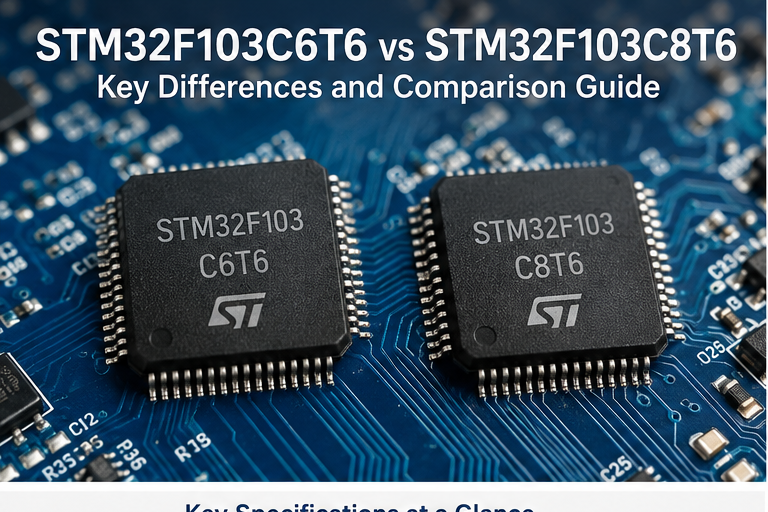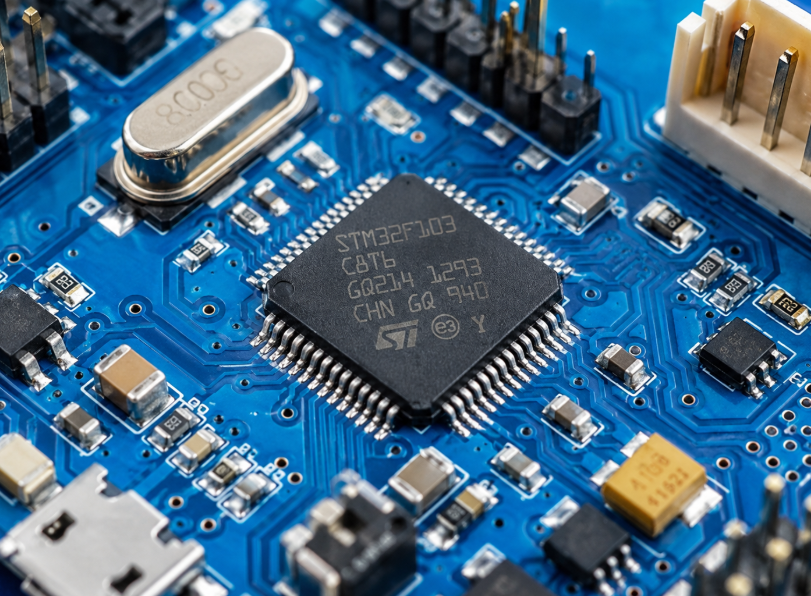
STM32F103C6T6 and STM32F103C8T6 look almost identical when you read the part numbers. Both belong to STMicroelectronics’ STM32F103 performance line, both use an Arm Cortex-M3 core, both can run at up to 72 MHz, and both are available in the same 48-pin LQFP package. That makes the choice seem simple.
Once you move from a datasheet comparison to a real PCB or purchasing requirement, the differences become more important. Flash capacity is only the first one. SRAM, communication interfaces, timers, firmware size, replacement direction, and sourcing requirements can all affect whether one device can safely take the place of the other.
From a component sourcing point of view, I would not approve a substitution just because the package and CPU core match. We normally check the complete manufacturer part number, memory use, pin functions, firmware configuration, temperature grade, and purchasing documentation before treating two MCUs as interchangeable.
This guide compares STM32F103C6T6 and STM32F103C8T6 from both engineering and procurement perspectives, so you can see where they are similar and where the choice can affect your design.
What Do These Two STM32 Part Numbers Mean?
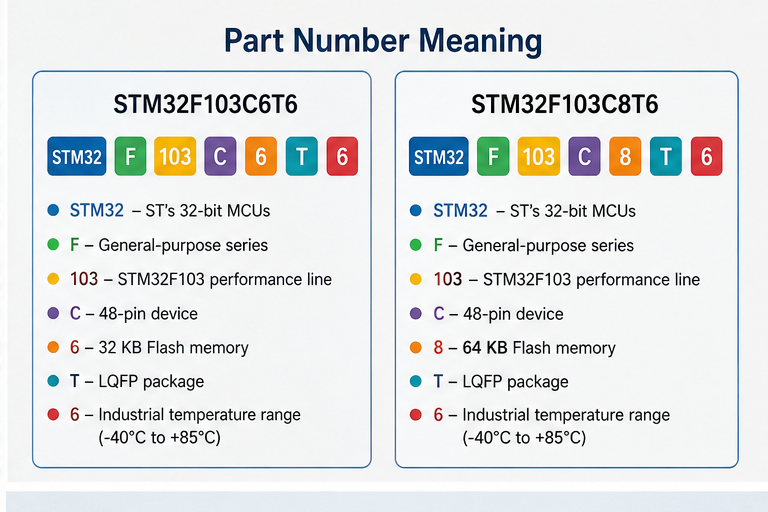
The easiest place to start is the ordering code itself. These two names differ by only one character in the middle, but that character changes the memory configuration.
For STM32F103C6T6:
- STM32 identifies ST’s 32-bit microcontroller family.
- F identifies the general-purpose product type.
- 103 identifies the STM32F103 performance line.
- C indicates a 48-pin device.
- The first 6 identifies 32 KB of Flash memory.
- T means LQFP package.
- The final 6 indicates the industrial temperature range of -40°C to +85°C.
For STM32F103C8T6, almost everything stays the same. The important change is the 8, which identifies 64 KB of Flash memory.
This small naming detail matters during purchasing. On an RFQ or BOM, “C6T6” and “C8T6” should never be shortened to something like “STM32F103C.” That shorter description no longer identifies the required memory density.
ST’s official ordering scheme confirms the 32 KB and 64 KB memory codes, the 48-pin “C” designation, the LQFP “T” package, and the temperature suffix used by these devices.
Key Specifications at a Glance
Both parts share the same processor architecture and several major hardware characteristics, but the C8T6 is not simply a C6T6 with more Flash.
| Specification | STM32F103C6T6 | STM32F103C8T6 |
|---|---|---|
| Manufacturer | STMicroelectronics | STMicroelectronics |
| MCU Family | STM32F103 | STM32F103 |
| CPU Core | Arm Cortex-M3 | Arm Cortex-M3 |
| Maximum CPU Frequency | 72 MHz | 72 MHz |
| Flash Memory | 32 KB | 64 KB |
| SRAM | 10 KB | 20 KB |
| General-Purpose Timers | 2 | 3 |
| Advanced-Control PWM Timer | 1 | 1 |
| SPI | 1 | 2 |
| I2C | 1 | 2 |
| USART | 2 | 3 |
| USB | 1 | 1 |
| CAN | 1 | 1 |
| 12-bit ADC | 2 | 2 |
| GPIO | 37 | 37 |
| Operating Voltage | 2.0–3.6 V | 2.0–3.6 V |
| Package | LQFP-48 | LQFP-48 |
| Temperature Grade for T6 | -40°C to +85°C | -40°C to +85°C |
ST classifies the C6 version within its low-density STM32F103 group and the C8 version within its medium-density group. The medium-density device brings more memory and more peripheral resources while retaining the same basic STM32F103 architecture. You can also review STMicroelectronics’ STM32F103 product information when confirming a design or BOM.
Difference: Flash Memory Capacity
STM32F103C6T6 Flash Memory
The STM32F103C6T6 provides 32 KB of embedded Flash memory.
For a compact embedded controller, 32 KB can still be useful. A project using a small control loop, basic ADC acquisition, GPIO, one communication interface, and carefully managed firmware may fit comfortably.
The problem usually appears after the first firmware version.
Diagnostics are added. Communication code grows. More error handling is introduced. A bootloader is requested. The engineering team decides to use a larger software library. Suddenly, a project that originally occupied well below 32 KB is sitting close to the memory limit.
That is why I would not choose a 32 KB MCU only because the first build fits.
What matters is remaining Flash after the production firmware is complete, not the size of an early prototype.
STM32F103C8T6 Flash Memory
The STM32F103C8T6 doubles the embedded Flash capacity to 64 KB.
The CPU does not become faster because of this change. Both devices still use the Cortex-M3 core at up to 72 MHz. What you gain is more room for program code and constant data.
That can make a noticeable difference when the firmware includes several modules, protocol handling, diagnostics, configuration storage structures, a bootloader, or more extensive fault handling.
You should still treat 64 KB as a defined resource, not unlimited space. Firmware can continue growing until 64 KB becomes restrictive as well.
How Flash Size Affects Your Application
When evaluating STM32F103C6T6 and STM32F103C8T6, check your compiled firmware instead of estimating memory requirements from the number of features.
Look at:
- current
.textand.rodatausage; - bootloader allocation;
- reserved Flash pages;
- configuration or calibration data stored internally;
- expected firmware expansion;
- debug features that may later remain in production;
- library and middleware size.
I normally prefer to see useful design margin rather than a firmware image sitting just below the device limit.
A board may work perfectly with 29 KB of firmware inside a 32 KB MCU. From a lifecycle perspective, though, the engineering team has very little room left. One larger protocol library or future product revision can force a component change.
If you are still deciding which MCU architecture and memory size fit the whole system, this guide on how to choose a microcontroller for an embedded system covers the broader selection process.
Difference #2: Application and Firmware Requirements
Flash receives most of the attention in comparisons between these devices. In practice, SRAM and peripheral resources can become equally important.
The STM32F103C6T6 provides 10 KB SRAM, while the STM32F103C8T6 provides 20 KB SRAM. ST’s family documentation also shows fewer communication interfaces and general-purpose timers on the low-density device.
That changes what the MCU can comfortably handle.
When STM32F103C6T6 Is Enough
The C6T6 makes sense when the firmware is compact and the hardware requirement already fits its available peripheral set.
A design may only require several GPIOs, ADC acquisition, one SPI bus, one I2C bus, one or two serial channels, USB or CAN, and a small amount of working memory. In that situation, choosing extra resources that will never be used offers little technical benefit.
Still, check SRAM carefully.
RAM is consumed by stack space, global variables, receive and transmit buffers, sensor data, communication queues, temporary calculations, RTOS objects, and library working memory. A firmware image can fit inside 32 KB Flash and still become unstable because its 10 KB SRAM is too tight.
Memory selection should always consider Flash and SRAM together.
When STM32F103C8T6 Is the Better Choice
The C8T6 gives you 20 KB SRAM, 64 KB Flash, up to two SPI interfaces, two I2C interfaces, three USARTs, and three general-purpose timers in the 48-pin configuration.
That extra capacity is useful when several software and hardware functions run together.
For example, a design may need one UART for debugging, another for an external module, I2C sensors, SPI memory, ADC sampling, timer-based control, and USB or CAN communication. The C8T6 gives the engineer more room to arrange these resources without redesigning the MCU platform immediately.
RAM can be the deciding factor when communication buffers become larger. USB, CAN queues, serial buffers, protocol state machines, and an RTOS can consume memory quickly.
This is one reason I would not describe the C8T6 as merely the “64 KB version” of the C6T6. The move from the low-density to medium-density STM32F103 configuration changes more than program storage.
Difference #3: Replacement and Design Compatibility
Are STM32F103C6T6 and STM32F103C8T6 Pin-Compatible?
For the C6T6 and C8T6 order codes discussed here, both devices use the 48-pin LQFP package.
ST also designed the STM32F103 family with compatibility between memory-density groups. Its documentation describes the low-density STM32F103x4/x6 devices as drop-in replacements within the wider STM32F103 family structure.
That is useful, but “pin-compatible” should not be interpreted as “every substitution works without checking anything.”
The C8 device has peripherals that are not available on the C6. A PCB originally designed around the C8 may use one of those extra interfaces.
Can You Replace C6T6 With C8T6 Directly?
Moving from STM32F103C6T6 to STM32F103C8T6 is usually the easier direction.
The package, CPU family, voltage range, major pin structure, USB, CAN, ADC architecture, and development environment remain closely related. A design using only the resources available on the C6 can often migrate to the C8 without a PCB redesign.
Firmware still needs review.
The development project should identify the correct MCU. Linker settings may also need to be updated if you want the program to use the additional Flash and SRAM. Clock configuration, peripheral initialization, option bytes, programming procedure, and production test settings should be validated on the replacement hardware.
Going the other way requires much more caution.
A product designed for the C8T6 may exceed 32 KB Flash, use more than 10 KB SRAM, or depend on the additional SPI, I2C, USART, or timer resources. In those situations, the C6T6 cannot be treated as an equivalent replacement even though it fits the same footprint.
What to Check Before Substitution
When our sourcing side receives an MCU substitution request, the useful question is not simply, “Does it fit the footprint?”
The review should cover:
- full manufacturer part number;
- Flash and SRAM use;
- package and pin count;
- supply voltage;
- clock requirements;
- every GPIO alternate function actually used;
- timer assignments;
- SPI, I2C and USART requirements;
- USB and CAN use;
- ADC channels;
- boot and programming method;
- option-byte configuration;
- operating temperature;
- firmware target and linker memory map.
The engineering team should approve the final change. A purchasing team can identify a possible replacement, but electrical and software compatibility need technical validation.
Difference #4: Availability and Component Sourcing
Why Availability May Differ Between the Two MCUs
At the time of checking, ST lists both STM32F103C6 and STM32F103C8 product families as Active and in volume production. That does not mean both exact order codes will always have the same availability in every distribution channel or region.
Stock changes independently from product status.
One supplier may have C8T6 material available from a recent lot while another has C6T6 stock from an older purchase. Packaging quantity, date code, country of origin, factory lot, lead time, and customer demand can also affect what is physically available.
For purchasing teams, this distinction matters:
Active lifecycle status tells you whether the manufacturer still supports the product family. Inventory tells you whether the material you need can actually be delivered under your order requirements.
Do not use one as a substitute for the other.
You can review STMicroelectronics components when checking related STM32 devices and other ST part numbers.
What Buyers Should Check Before Ordering
For STM32F103 devices, I would ask for the complete MPN first: STM32F103C6T6 or STM32F103C8T6, not only “STM32F103.”
Then confirm quantity, packaging, manufacturer marking, date or lot requirements if applicable, lifecycle information, traceability expectations, and required compliance documents.
For products entering regulated markets, purchasing teams may also need current environmental declarations. The European Commission’s RoHS information explains the EU restriction framework for hazardous substances in electrical and electronic equipment. The ECHA Candidate List is also relevant when REACH/SVHC information is required.
Ask for documentation tied to the actual manufacturer and requested part number. A generic “RoHS compliant” sentence in a quotation is weaker than a current manufacturer declaration or traceable compliance record.
For independent-channel sourcing, packaging condition deserves the same attention. Check labels, seals, reel or tray condition, moisture protection where applicable, part markings, quantity, and lot information before material enters production.
Difference #5: Choosing Between STM32F103C6T6 and STM32F103C8T6
Choose C6T6 for Smaller Embedded Projects
The STM32F103C6T6 remains a reasonable choice when your design fits comfortably inside its limits.
I would consider it when:
- firmware is well below 32 KB;
- SRAM consumption stays comfortably below 10 KB;
- one SPI and one I2C interface are enough;
- two USARTs meet the communication requirement;
- two general-purpose timers plus the advanced-control timer cover the application;
- future firmware growth is limited and understood.
The important word is comfortably.
If Flash usage is already close to 32 KB during development, choosing the C6 simply because the current build passes compilation can create unnecessary restrictions later.
Choose C8T6 When More Program Space Is Needed
The STM32F103C8T6 is the stronger option when you need additional program space, more working RAM, or more communication and timer resources.
| Design Question | C6T6 | C8T6 |
|---|---|---|
| Firmware comfortably below 32 KB? | Good fit | Good fit |
| Firmware may grow beyond 32 KB? | Limited | Better choice |
| RAM demand approaching 10 KB? | Limited margin | 20 KB available |
| Need second SPI? | No | Yes |
| Need second I2C? | No | Yes |
| Need third USART? | No | Yes |
| Need third general-purpose timer? | No | Yes |
| Existing C6 PCB needs more memory? | — | Usually the easier upgrade path |
| Existing C8 design being reduced to C6? | Requires detailed review | — |
For a new design, the core decision is not “Which MCU is larger?” It is “Which one gives the firmware and hardware enough room for the expected product life?”
Conclusion
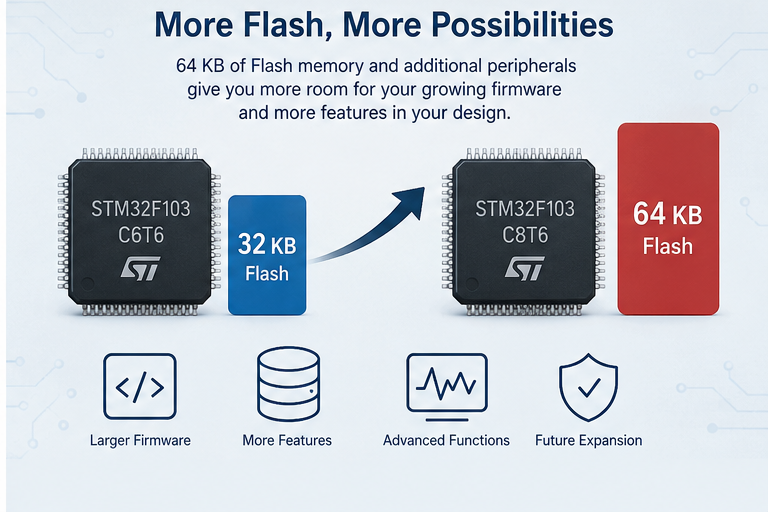
The main difference between STM32F103C6T6 and STM32F103C8T6 starts with Flash memory: 32 KB versus 64 KB. Once you look deeper, the C8T6 also provides twice the SRAM, more communication interfaces, and one additional general-purpose timer.
Both use the same Arm Cortex-M3 architecture, support up to 72 MHz operation, use the 48-pin LQFP package in these order codes, and share many core peripherals. This makes migration from C6T6 to C8T6 relatively straightforward in many designs. Replacing a C8T6 with a C6T6 deserves more care because the smaller device may not support the existing firmware size, RAM use, or peripheral configuration.
From a procurement perspective, check the full MPN rather than only the STM32F103 family name. Verify memory density, package, temperature suffix, lifecycle status, stock source, lot information, documentation, and the engineering approval for any substitute.
If you are also sourcing electronic components, Duolink Electronics is an independent electronic components supplier supporting integrated circuits, semiconductors, passive components, connectors, and other electronic parts. Our team can assist with BOM sourcing, part-number checks, inventory inquiries, and hard-to-find component sourcing. You can also browse our integrated circuits and MCU sourcing range or leave your requirements through the website for further review.
FAQ
Is STM32F103C8T6 a direct replacement for STM32F103C6T6?
In many C6T6-based designs, the C8T6 can be used as the upgrade candidate because both use LQFP-48 and belong to the compatible STM32F103 family. Firmware, pin functions, programming settings, and the production test process should still be validated before approval.
Can STM32F103C6T6 replace STM32F103C8T6?
Not automatically. The C6T6 has only 32 KB Flash and 10 KB SRAM and provides fewer communication interfaces and timers. Check the compiled firmware size, RAM consumption, and every peripheral used by the existing design first.
What is the biggest difference between STM32F103C6T6 and STM32F103C8T6?
Flash memory is the most visible difference: 32 KB for C6T6 and 64 KB for C8T6. The C8T6 also has 20 KB SRAM versus 10 KB on the C6T6 and offers more SPI, I2C, USART, and timer resources.
Do both MCUs use the same LQFP-48 footprint?
Yes, the C6T6 and C8T6 order codes discussed here both use a 48-pin LQFP package. Pin compatibility does not remove the need to check peripheral use and firmware requirements.
What should I provide when requesting an STM32F103C6T6 or STM32F103C8T6 quotation?
Provide the full manufacturer part number, required quantity, packaging preference, target delivery date, and any date-code, lot, traceability, or compliance requirements. For a replacement request, also state the original MPN so the technical differences can be reviewed.
Should I choose STM32F103C8T6 just because it has more memory?
Not necessarily. If the application fits comfortably within the C6T6 memory and peripheral limits, the C6T6 may already meet the design requirement. The better choice is the MCU that supports your present firmware, expected growth, hardware interfaces, and long-term sourcing plan without unnecessary redesign.