Electronic component sourcing is not complete when the part number, quantity, and delivery date match the purchase order. A buyer also needs enough evidence to connect the physical components received to the lot, source, packaging, and records offered before shipment. That connection is component traceability.
Traceability does not guarantee that a component is genuine, unused, compliant, or suitable for the intended design. It does, however, make inconsistencies easier to identify and investigations easier to control. When records are missing, a buyer must rely more heavily on inspection, testing, and a risk-based approval process.
Purchasing managers, engineers, and electronics manufacturers do not need paperwork for its own sake. They need evidence that fits the application, agrees across records, and remains linked to the lot received.
What Is Component Traceability in Electronic Component Sourcing?
What Electronic Component Traceability Actually Means
Component traceability is the ability to follow a part or lot backward through its supply history and forward into receiving, storage, production, and finished assemblies. Depending on the supply channel and component, the record may connect:
- The exact manufacturer part number and suffix
- Manufacturer, lot, date, and trace codes
- Original packaging and label information
- The seller and prior source, where disclosed
- Purchase order, packing list, and shipment details
- Incoming inspection or test records
- The internal receiving lot and production jobs that consumed the material
A useful trace record answers three questions: What is the material? Where did this specific lot come from? Where did it go after receipt? The record should be specific enough to identify the affected material without placing unrelated inventory on hold.
Traceability vs. Authenticity and Quality Verification
These terms support one another, but they are not interchangeable.
| Control | Main Question | Important Limitation |
|---|---|---|
| Traceability | Can the component be linked to a source, lot, and documented transaction history? | Documents can be incomplete, altered, or unrelated to the physical lot. |
| Authenticity verification | Is the part consistent with a genuine product from the stated manufacturer? | No single photo, label, or test is conclusive in every case. |
| Quality verification | Does the lot meet the agreed condition, handling, and performance requirements? | A genuine component can still be damaged, aged, mishandled, or unsuitable. |
A Certificate of Conformance, or CoC, is a supplier statement. Its value depends on who issued it, what it covers, and whether the identifiers match the delivered goods. It should not be treated as independent proof of authenticity.
Why Traceability Can Vary Between Supply Channels
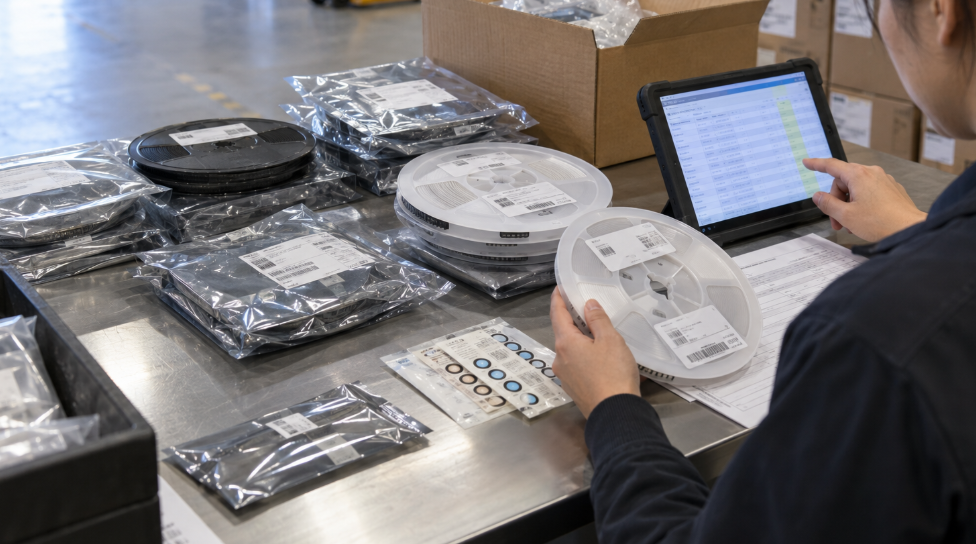
Traceability is usually strongest when goods remain in an unbroken manufacturer-authorized channel and the relevant transaction records are preserved. It may become less complete when inventory passes through multiple owners, is split from a larger lot, is repackaged, or comes from excess stock.
That does not mean every repacked or open-market component is unacceptable. Repacking may be legitimate, particularly when a reel has been divided or moisture-sensitive parts have been prepared for shipment. The buyer should identify who performed the repacking, why it was needed, how the quantity and lot identity were controlled, and whether the packaging still meets the component’s handling requirements.
Do not ask only whether a supplier “has traceability.” Define the required traceability depth in the RFQ and ask the supplier to state any gaps before the order is placed.
What Information Should Be Traceable for Electronic Components?
Manufacturer Part Number, Date Code, and Lot Code
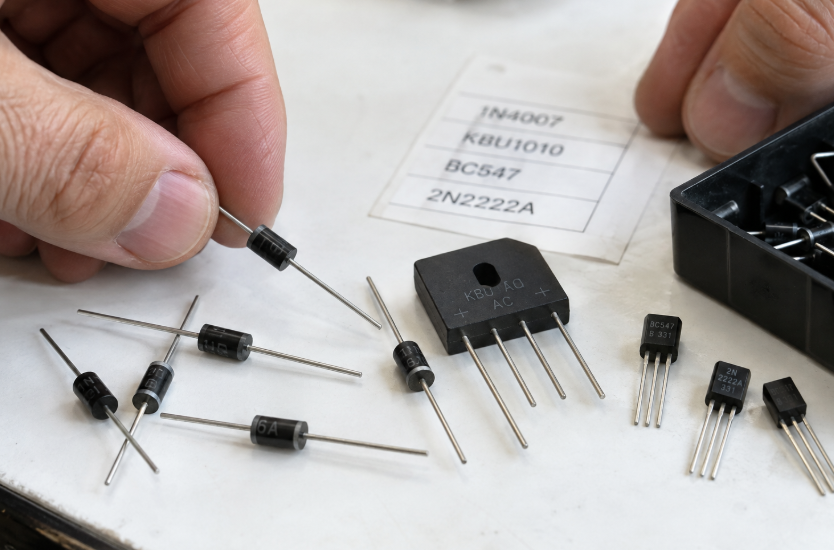
Start with the complete manufacturer part number, including package, temperature grade, tolerance, qualification, tape-and-reel, and other orderable suffixes. A base number can describe a family, while the suffix identifies the version that purchasing and engineering actually approved.
Date codes and lot codes add production context, but they must be interpreted using manufacturer-specific information. A four-digit field may follow a year-week format, yet the same pattern should not be assumed across every product family.
As explained in DuoLink’s guide to electronic component date codes, buyers should compare the body marking with the label, package type, lot information, and applicable marking guide.
For every shipment, record whether the quantity is single-lot, mixed-lot, or unknown. If the application requires a date-code limit or a single production lot, place that condition on the RFQ and purchase order. Do not wait until receiving inspection to discover that the supplier’s available quantity combines several lots.
Original Source and Chain of Custody
Chain of custody describes the documented sequence of possession or control. For components, useful evidence may include the original manufacturer or authorized-channel invoice, packing label, prior purchase record, transfer record, or a redacted document that still preserves the fields needed to connect the lot.
Commercially sensitive information may be removed, but the remaining record must still be usable. A heavily redacted invoice that hides the part number, quantity, date, and source does not establish much. Buyers should agree in advance which fields may be redacted and which must remain visible.
The GS1 Global Traceability Standard provides a useful general principle: traceability depends on linking physical flow with information flow.
In electronic component sourcing, the same logic applies. A document that cannot be linked to the delivered reel, tray, tube, or bag has limited evidentiary value.
Packaging, Quantity, and Supporting Records
Traceability should extend to the packaging unit, not stop at a PDF. Before shipment, request clear images of the full label and packaging condition. Compare:
- MPN and manufacturer name
- Quantity and package type
- Date, lot, and trace codes
- Country or site codes, if used by the manufacturer
- Reel, tray, tube, or dry-pack condition
- Seal status, desiccant, and humidity indicator card where applicable
- Signs of relabeling, label-over-label application, or inconsistent print fields
Quantity reconciliation is especially useful. The amount shown on the label, packing list, CoC, and shipment should agree or have a documented explanation.
A partial reel is not automatically suspicious, but the record should show how its quantity and identity were maintained after splitting.
Why Does Traceability Reduce Counterfeit and Quality Risks?
Identifying Inconsistent Labels, Lots, and Documentation
Traceability creates cross-checks. If the outer carton shows one lot, the reel label another, and the CoC a third, the buyer has a reason to stop and clarify before the material enters production.
Other warning signs include:
- Different date codes presented as a single lot
- Quantities that do not reconcile across documents
- A packing format inconsistent with the stated source
- Label fields that conflict with the manufacturer’s current or historical format
- Source documents dated after the alleged downstream transaction
- Inspection photos that do not show the lot offered in the quotation
An inconsistency is a warning sign, not automatic proof of counterfeiting. Packaging formats change, manufacturers use subcontractors, and legitimate inventory can be repacked.
Quarantine the material, request clarification, and apply risk-based verification before reaching a conclusion.

Connecting Physical Components With Their Supply History
The strongest records contain matching identifiers across the transaction. A buyer should be able to connect the supplier’s quotation and pre-shipment photos to the delivered packaging, receiving record, and retained inspection images.
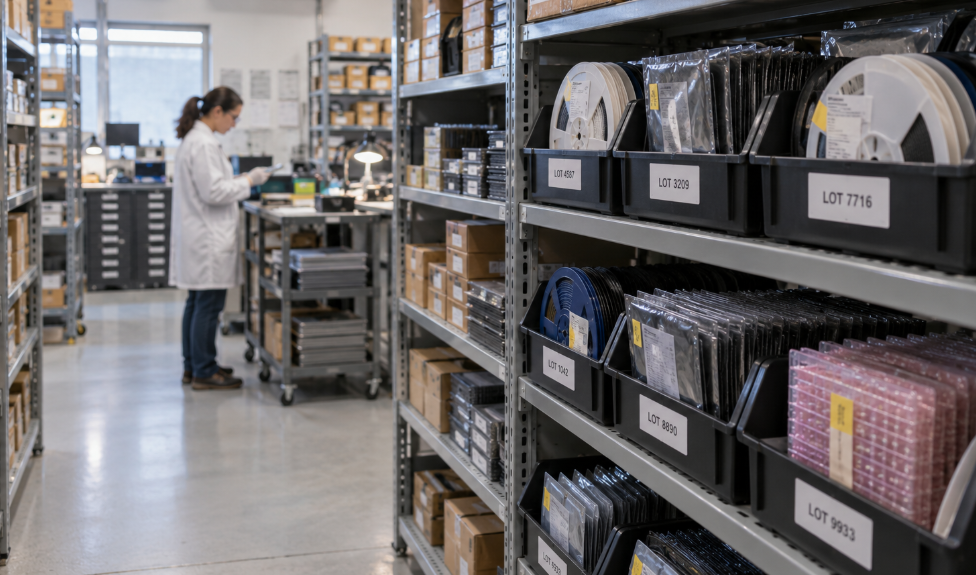
One practical method is to assign an internal receiving lot at goods-in. Store the supplier lot, manufacturer lot, date code, purchase order, received quantity, inspection status, and storage location against that internal number.
When material is issued to production, record the work order or finished assembly batch that consumed it.
This discipline prevents a common failure: keeping a supplier’s documents in one folder while the actual components are combined with other lots in stock. Once physical identity is lost, even good upstream paperwork may no longer support an effective investigation.
Why Traceability Should Be Combined With Inspection and Testing
Paperwork can support confidence, but it cannot reveal every problem. Records may be genuine while the components were damaged by moisture, electrostatic discharge, oxidation, poor storage, or handling. Documents may also have been copied from another lot.
Inspection should be selected according to source, part type, value, application criticality, and known failure modes. It may progress from document and packaging review to:
- External visual inspection
- Dimensional checks
- X-ray or XRF analysis
- Solderability evaluation
- Electrical testing
- Destructive analysis
SAE’s AS6171 framework addresses uniform requirements and methods for testing suspect or counterfeit electrical, electronic, and electromechanical parts.
Its external visual inspection slash sheet covers areas such as remarking, resurfacing, and surface-texture analysis.
Not every order requires every test. Destructive methods consume samples, electrical testing needs defined limits and fixtures, and results are only meaningful when the method, sample plan, acceptance criteria, and laboratory competence are appropriate.
Higher-risk applications may require customer, quality, or engineering approval before the inspection plan is finalized.
How Does Traceability Help When a Component Problem Occurs?
Isolating Affected Lots and Production Batches
When a component fails incoming inspection or creates a field concern, traceability defines the containment boundary.
The quality team can identify which supplier lot is affected, how much remains in stock, which work orders used it, and which finished units may require review.
Without that link, a company may have to quarantine every unit of the same MPN, including material from other suppliers or production lots. That expands disruption and may still fail to locate assemblies already shipped.
Supporting Root-Cause Analysis and Supplier Investigation
Root-cause analysis depends on evidence. Useful records include:
- The complete MPN
- Lot and date codes
- Receiving date
- Packaging photos
- Inspection results
- Storage and handling history
- Production job
- Failure symptoms
- Retained samples
Traceability helps the supplier compare the complaint with its transaction and source records. It also helps engineering separate possible causes, such as a wrong suffix, mixed revision, handling damage, soldering process issue, latent component defect, or suspect part.
Traceability does not determine the cause by itself. It narrows the population and preserves the facts needed to test competing explanations.
Preventing Unnecessary Production Stops and Material Scrap
Precise containment protects both quality and continuity. If records confirm that only one receiving lot fed a defined group of work orders, unaffected material may be evaluated separately rather than scrapped by association.
The decision to release unaffected stock should still follow the buyer’s quality procedure. Purchasing should not release inventory solely because its paperwork looks different.
Quality and engineering may need to review the failure mechanism, common source, storage conditions, and inspection evidence first.
Why Is Traceability More Important for Obsolete and Hard-to-Find Components?
Longer Supply Chains Create More Traceability Gaps
Obsolete components may have been stored for years and transferred between OEMs, contract manufacturers, resellers, liquidators, and independent distributors.
Each transfer can break the original documentation trail or separate a partial quantity from its first packaging.
The age of a component alone does not make it defective, and a recent date code does not guarantee suitability. Buyers need evidence about storage, packaging, lead condition, moisture control, and solderability where relevant.
The longer and less transparent the route, the more the inspection plan should compensate for missing history.
Mixed Lots, Excess Inventory, and Repackaged Stock
Excess inventory can be a legitimate source of scarce parts, but its condition and records vary. Material may be:
- Unused production surplus
- Canceled inventory
- Line returns
- Partial reels
- Stock that has already changed hands several times
Ask the supplier to separate lots and quote them separately when practical. If mixed lots must be accepted, record each lot, its quantity, and the inspection evidence.
Never allow several lots to be relabeled as one internal lot in a way that destroys their original identities.
Repackaging also needs a record. For moisture-sensitive devices, buyers should ask who opened and resealed the moisture barrier bag, whether exposure time is known, and what dry-pack controls were used.
Any baking or repacking decision should follow the component manufacturer’s guidance and the buyer’s applicable handling procedure.
Why Open-Market Components Need Stronger Verification
Open-market sourcing can help resolve shortages, end-of-life requirements, or urgent maintenance needs. It also reduces the buyer’s ability to rely solely on manufacturer-authorized transaction history.
Verification must therefore be based on the actual source, documents, lot condition, and application risk.
For a noncritical prototype, a buyer may accept limited history after appropriate inspection. A safety-critical, automotive, aerospace, medical, or long-life industrial application may require:
- Stronger traceability
- A defined test plan
- Customer approval
- Rejection of material with an unresolved source gap
These decisions should be written into the sourcing procedure rather than improvised during a shortage.
What Traceability Documents Should Buyers Request From Suppliers?
Certificate of Conformance and Original Packaging Records
A CoC should identify the supplier, customer or purchase order where applicable, exact MPN, quantity, lot or date information where agreed, and a clear conformity statement.
Check who issued and signed it. A distributor-issued CoC is not the same as a manufacturer-issued CoC, and neither should be described as proof beyond its actual scope.
Original packaging photos or records can support the link between the document and the material. Request uncropped images of:
- The label
- Reel or tray
- Inner packaging
- Outer packaging
- Seal condition
For higher-risk orders, ask for a dated photo set or another agreed method that shows the photographed inventory is the lot being offered.
Purchase, Packing, and Source Documentation
The required documents should be proportionate to the risk. The following matrix can be adapted to the buyer’s quality system.
| Evidence | What to Verify | Escalate When |
|---|---|---|
| Supplier quotation and lot disclosure | Exact MPN, quantity, source type, lot count, and date-code requirement | Lot identity is unknown or changes after order |
| CoC | Issuer, referenced PO, MPN, quantity, lot/date fields, and scope | Issuer or covered material cannot be established |
| Packing list | Shipment quantity and package units | Quantity conflicts with labels or invoice |
| Source or chain-of-custody record | Parties, dates, MPN, quantity, and link between transfers | Essential fields are missing or chronology is inconsistent |
| Packaging photographs | Complete labels, lot identifiers, condition, and seal status | Images are cropped, reused, or do not match delivered goods |
| Receiving and inspection record | Internal lot, sampling, method, result, and disposition | Material was mixed before inspection or acceptance is unclear |
Redacted source records may be acceptable if the buyer can still verify the required chain. Agree on that standard before issuing the purchase order. Otherwise, the supplier may interpret “traceability available” very differently from the buyer.
Inspection and Test Reports for Higher-Risk Components
A useful report identifies:
- The exact sample and lot
- Test method
- Equipment where relevant
- Sample size
- Acceptance criteria
- Observations and results
- Test date
- Responsible organization
Do not rely on a generic “pass” page that omits sample identity or test method.
Buyers should also ask whether tests were destructive and whether the tested pieces will be excluded from shipment.
For electrical tests, confirm that the tested parameters and conditions address the relevant risk. A basic continuity check does not verify every datasheet limit or prove long-term reliability.
How Can Buyers Build Traceability Into the Component Sourcing Process?
Define Traceability Requirements Before Sending the RFQ
Traceability works best as a purchase requirement, not a last-minute document request. The RFQ should state:
- Exact MPN and approved alternatives, if any
- Required quantity and packaging
- Single-lot or mixed-lot acceptance
- Date-code limits and how they will be evaluated
- Required source disclosure and traceability documents
- Pre-shipment photo, inspection, and test requirements
- Application or quality-system constraints
- Approval steps for any deviation
For a BOM, classify lines by risk rather than applying one expensive control to every item.
High-value semiconductors, obsolete parts, safety-related devices, and lots from a new source may need deeper evidence than common low-risk passive components from an established channel.
Verify Lot and Source Information Before Shipment
Perform a document-to-material review before the shipment leaves when time allows. Compare the quotation, photos, labels, CoC, packing information, and disclosed source.
Resolve mismatches in writing and update the purchase record if an approved lot changes.
Pre-shipment review saves time, but it does not replace receiving inspection. The delivered material must still be checked against the approved evidence.
If seals, labels, quantities, or lots differ, quarantine the shipment until the discrepancy is resolved.
Keep Receiving and Quality Records After Delivery
At receipt, assign or confirm an internal lot and preserve the relationship among the supplier lot, manufacturer identifiers, storage location, and inspection decision.
Keep original photos and reports under controlled filenames rather than replacing them with compressed screenshots.
When stock is split, repacked, transferred, returned, or issued to production, record the movement. Define a retention period based on:
- Product life
- Warranty period
- Regulatory requirements
- Customer requirements
- Application risk
- The buyer’s quality system
Access control and revision history also matter. A traceability record should show what was known at the time, not only the latest edited version.
For support with a part-number inquiry or BOM, buyers can contact DuoLink Electronics and state the manufacturer, complete MPN, quantity, application, date-code limits, lot requirements, and required documents at the beginning of the request.
Conclusion
Component traceability gives electronic component sourcing a defensible evidence trail. It connects part identity, source, lot, packaging, inspection, receiving, and production use.
That connection helps buyers detect inconsistencies before shipment, contain affected material when a problem occurs, and avoid treating every unit of an MPN as equally suspect.
Traceability is not a substitute for authenticity assessment, quality inspection, testing, or engineering approval. Its value depends on the completeness of the chain and the buyer’s ability to link each record to the physical lot.
DuoLink Electronics is an independent electronic component supplier supporting global component inquiries, BOM sourcing, and hard-to-find part requests.
Send the complete manufacturer part number, quantity, target application, date-code or lot requirements, and required documentation with your RFQ so the available source and verification approach can be reviewed before purchase.
Frequently Asked Questions
Does a Certificate of Conformance Prove That Electronic Components Are Genuine?
No. A CoC states conformity within the issuer’s declared scope. Buyers should verify who issued it, which lot it covers, and whether its identifiers match the physical components.
Source review, inspection, and testing may still be required.
Is Original Manufacturer Packaging Required for Full Traceability?
Original packaging strengthens the link to manufacturer identifiers, but its presence alone does not prove authenticity.
Legitimate partial quantities may be repacked. When that happens, document who repacked the material, why it was repacked, how the lot was controlled, and how handling requirements were maintained.
Can Different Date Codes Be Accepted in One Shipment?
Different date codes can be accepted if the purchase requirement allows mixed date codes and each lot remains identifiable.
For process-sensitive or regulated applications, engineering, quality, or customer requirements may call for a single lot or defined date-code limit.
What Should a Buyer Do When Upstream Traceability Is Unavailable?
Treat the gap as a risk input. Ask for the available source history, current lot photos, packaging information, and inspection evidence.
Then decide whether additional testing, sample approval, customer authorization, restricted use, or rejection is appropriate.
How Long Should Component Traceability Records Be Kept?
There is no universal period for every component.
Set the retention period according to the finished product’s life, warranty, application risk, contractual terms, customer requirements, and applicable quality or regulatory obligations.
Is Traceability More Important Than Electrical Testing in Electronic Component Sourcing?
They answer different questions.
Traceability explains the component’s documented identity and supply history. Electrical testing evaluates selected performance characteristics under defined conditions.
Higher-risk sourcing decisions often require both, supported by visual inspection and application-specific engineering review.


 English
  German
  Spanish
  French
  Chinese
  Italian